
Memorandum
- From
- Connor Quincy
- Date
- Filed
- News·5 min to read
- Re
What the Air Force’s Minuteman III AI Project Actually Does
ReWhat the Air Force’s Minuteman III AI Project Actually Does
The proposed AI layer would search and visualize maintenance data scattered across about 60 systems. It is designed to support engineers and sustainment staff, not to launch missiles.
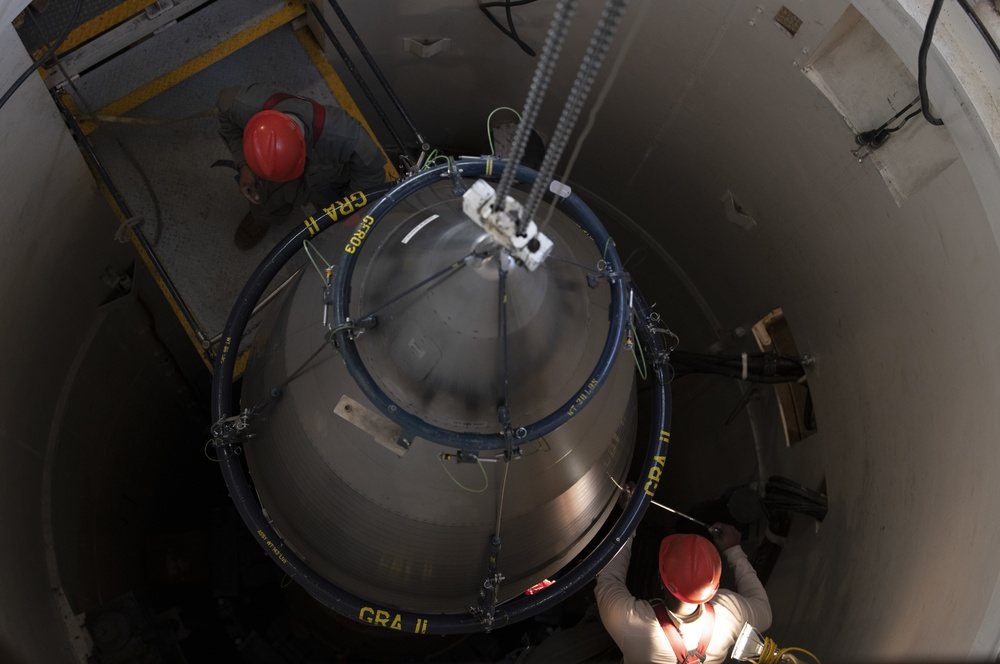
The phrase “AI for nuclear missiles” collapses several very different functions into one alarming image. The U.S. Air Force’s latest Minuteman III request is narrower and more mundane: it wants to know whether industry can build an AI-powered interface that helps people find technical information scattered across about 60 disconnected systems.
That distinction matters. The request for information comes from the Air Force Nuclear Weapons Center and focuses on data aggregation and visualization for Minuteman III sustainment. It does not describe an AI launch authority, target-selection system or command-and-control replacement.
The underlying problem is one familiar to large organizations with decades-old infrastructure. Critical information has accumulated in databases, shared networks and local hard drives that were never designed to operate as a single environment. For Minuteman III, the Air Force lists engineering drawings, specifications, interface-control documents, supply data, maintenance records, risk repositories, technical orders, fleet-health metrics and forecasts among the sources that need to be searched together.
Today, staff often have to assemble that information manually. The Air Force says the fragmented environment makes it labor-intensive to assess risks such as parts attrition and functional age-out. Those terms point to two different sustainment questions: whether enough usable components will remain available and whether aging equipment is approaching a point where it can no longer perform its required function.
The envisioned software would create a single interface over those sources. A user could submit a question, retrieve records from connected systems and move into technical material without opening each source separately. The same tool is expected to improve access to visual engineering content, including 2D and 3D drawings and functional diagrams.
There is an important design constraint: the AI layer is not supposed to become the authoritative database. The performance work statement says it should pull data from existing authoritative sources in near real time. That reduces one obvious risk of generative systems — allowing a model’s output to silently replace the underlying record. The contractor would still have to implement safeguards and continuous validation to ensure that the tool accurately reflects source data.
The Air Force also proposes concrete performance thresholds. At least 95 percent of the initial set of data sources should be connected and queryable. Search results should reach 99 percent accuracy when checked against source data. A separate measure would track whether the tool actually reduces the time and manual effort needed for data compilation.
Security requirements underline how different this is from a consumer AI deployment. The initial effort is expected to operate with Controlled Unclassified Information at Impact Level 5. Later efforts could potentially involve Secret data at Impact Level 6. Personnel who need access would be required to hold whatever clearances the government specifies.
The launch side remains separate in the material the Air Force has published. Official Minuteman III information describes two-officer combat crews on continuous alert in underground launch control centers, backed by a redundant communications network linking them to national command authorities. Nothing in the data-tool RFI assigns those functions to AI.
Why invest in a new information layer now? Minuteman III is a 1970-era system whose life is being stretched while the Air Force transitions toward Sentinel. The current Minuteman force includes 400 missiles across bases in Wyoming, Montana and North Dakota, and the Air Force says much of the supporting infrastructure has been in service for more than half a century.
That produces a practical tension. The physical system is old, but its maintainers need modern ways to understand its condition. Replacing every legacy database at once is difficult; building a trusted layer that can search across them may be faster.
Even that outcome is not guaranteed. The notice is a request for information, a market-research step rather than a contract solicitation. The next stage depends on what the Air Force learns from industry. If a procurement follows, the most consequential tests will be less cinematic than the headline: whether the system retrieves the correct part record, points to the right drawing, preserves source traceability and saves maintainers enough time to justify putting AI into a highly sensitive technical workflow.
71

Source: U.S. Air Force Request for Information on the Minuteman III AI Data Tool