Memorandum
- From
- Caroline Mercer via Fast Company
- Date
- Filed
- Culture·6 min to read
- Re
Ma Yansong's Lucas Museum Opens as a $1 Billion Bet on the Showstopper Building
ReMa Yansong's Lucas Museum Opens as a $1 Billion Bet on the Showstopper Building
The Chinese architect's audacious new museum in Los Angeles arrives as the profession turns away from signature architecture, testing whether the starchitect model can survive.
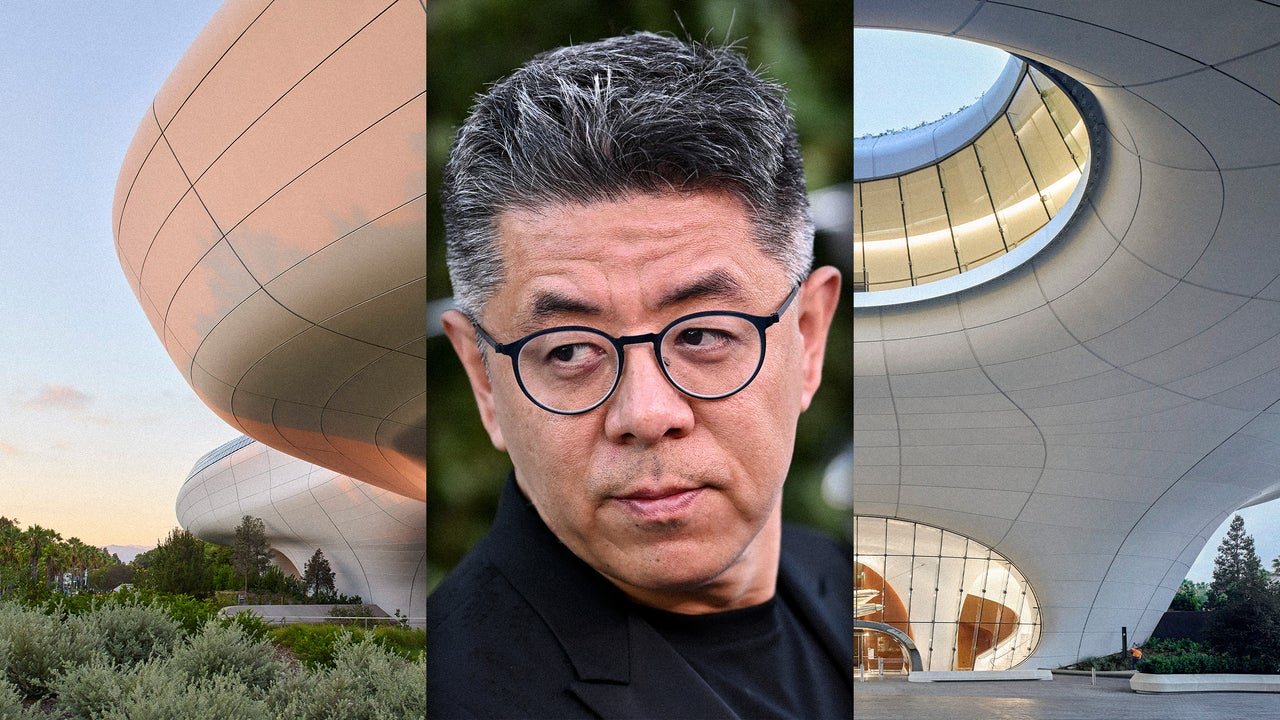
The Lucas Museum of Narrative Art has opened in Los Angeles's Exposition Park, a $1 billion building designed by Ma Yansong that stands as one of the most audacious architectural bets in recent memory. The museum, which houses filmmaker George Lucas's art collection, covers more than 300,000 square feet and blurs its surfaces into parkland designed by the L.A.-based landscape architects Studio-MLA. Clad in a warped grid of white polymer panels and topped with an oil-black solar array and a planted artificial hill, the building has been compared to a spaceship, an aerodynamic meteor, and an amphibian mid-metamorphosis.
Ma, 51, is the face and creative leader of MAD Architects, the Beijing-based firm with offices in Los Angeles and Rome that he has run for 22 years. He is arguably the most famous architect in China and one of the most famous in the world. His curvy and adventurous buildings have become landmarks across his native country, from an opera house in Harbin that spills out like an open-armed octopus to a crater-esque sports stadium in Quzhou to a recently completed cluster of museums in Shenzhen that resemble gigantic boulders. Several large-scale projects have also been completed outside China, including the spiraling Fenix Museum in Rotterdam and an apartment building in Denver with a rip through its facade.
The Lucas Museum is, in some ways, Ma's most significant project yet. Its world-famous founder, its controversial origin story, and its divisive curatorial stance only add to the intrigue of the building's unavoidably audacious form. Ma is unperturbed by the spaceship comparison. He often speaks about his own projects in contrast to what he calls normal buildings, meaning it as no slight to either. He argues there is a need in cities for both the background buildings and those that stand out. What matters, he says, is that there are buildings that connect people to a place and create an emotional reaction. «It's like listening to music or reading a book. When you close a book, you find that new side of you, right? You find new thinking. That's what museum architecture should do,» he says.
The museum opens as the world is generally trending away from this kind of look-at-me architecture. As Frida Escobedo, the architect behind Centre Pompidou's renovation and the new wing of the Metropolitan Museum of Art, recently said, «The idea of the starchitect making grand gestures with huge commissions is over.» Concerns about the environmental footprint of buildings and the long-term viability of almost any project have made developers and government officials wary about investing in expensive, signature buildings. They are seeing climate change ravaging the operating costs and resilience of one-of-one buildings. With rising material costs and growing geopolitical instability, the case for building something audacious is faltering.
Architects are finding themselves spending more time working on renovations or adaptive reuse projects, grappling with issues like embodied carbon and housing affordability. In 2022, for the first time in 20 years, the majority of architecture firms' billings came from retrofits rather than new builds, and the scales are still tipping toward renovation. Ma is uniquely talented in bringing people, and their money, on board with his unique propositions. But his success comes at an interesting time for the profession, as the old guard of star architects, including Frank Gehry, Zaha Hadid, Norman Foster, and Rem Koolhaas, are either aging or already dead. Ma, and many of his peers who also have a taste for the experimental, are now navigating a world where the business model of the genius showman architect is being pressure-tested.
«The business is probably more of a kind of whaling industry than it is fishing,» says Bjarke Ingels, founder of Bjarke Ingels Group and a star architect in his own right. «[Signature building projects] are few and far between, but they will probably always exist.» Ma may still be able to have it both ways. His inventive designs attract clients who are interested in creating landmark buildings, just as much as they lure in developers hoping for a clever spin on a tried-and-true building type. Forthcoming work ranges from bold new museums to quieter adaptive reuse projects and environmentally conscious structures.
Since founding his firm at the early age of 29 and growing it to nearly 200 employees, Ma has built a broad portfolio of projects that have cemented his place in the architectural elite. High-profile efforts like the Lucas Museum are not all Ma is able to do, but when he does them, he does not hold back. And almost every time, his designs make the case for the showstopper building and, by extension, the star architect.
2