
Memorandum
- From
- Derek Weston
- Date
- Filed
- Sports·6 min to read
- Re
What Dortmund’s 3-2 win over Arsenal actually showed
ReWhat Dortmund’s 3-2 win over Arsenal actually showed
The score was only a friendly result, but the structure of the game mattered: Dortmund’s three goals came from teenagers, Arsenal twice cut the deficit, and both clubs now move quickly toward trophy matches.
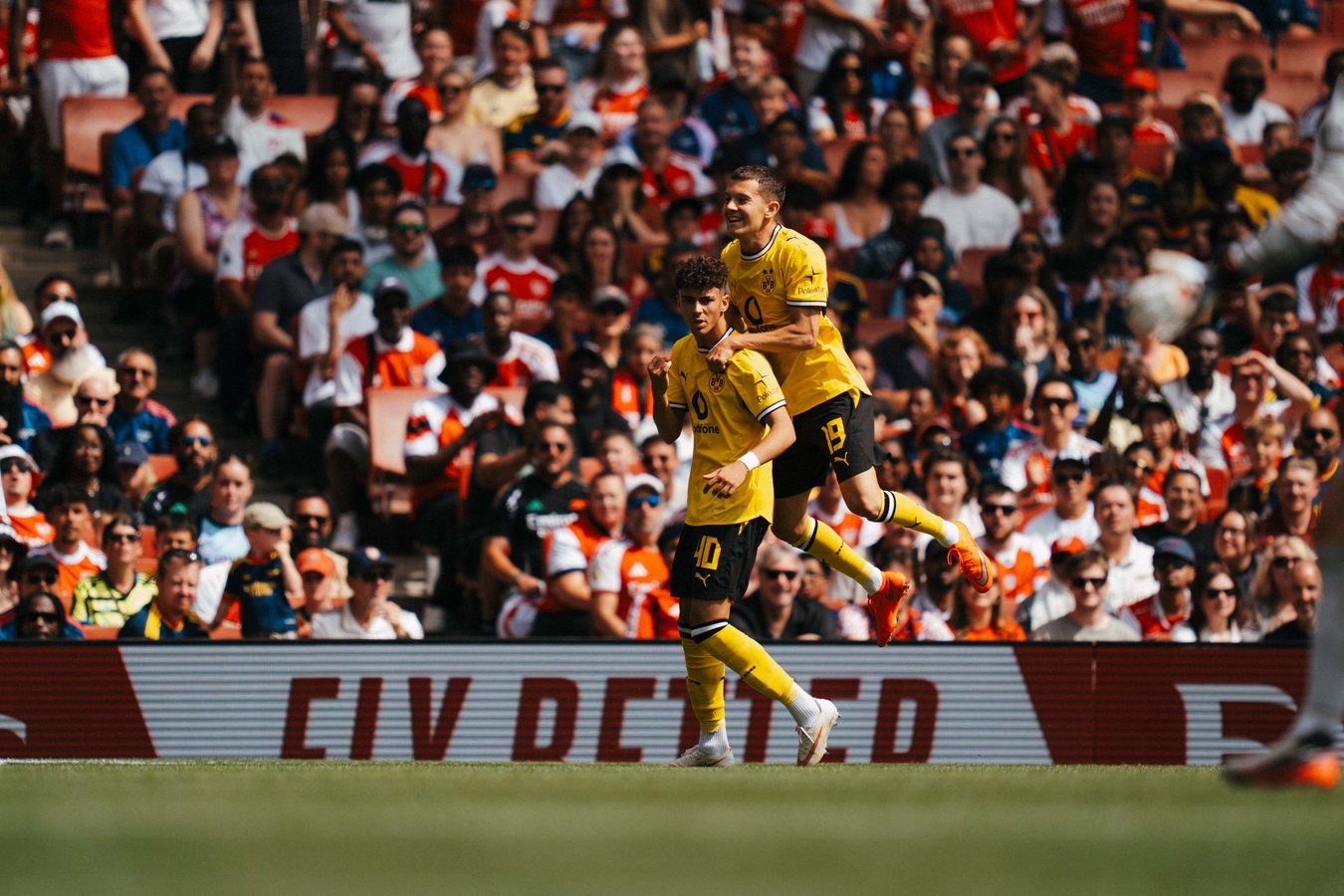
The useful way to read Borussia Dortmund’s 3-2 win over Arsenal is not as a forecast for the coming season. It is better understood as a concentrated preseason test that revealed something specific about both squads: Dortmund found production from three teenagers, while Arsenal showed enough attacking response to stay in the game but not enough control to erase the damage. The result matters less than the sequence of problems and solutions each team carried away from north London.
The match at Emirates Stadium began with Arsenal on the front foot. The hosts created early pressure, yet Dortmund scored first in the seventh minute. Fabio Silva and Felix Nmecha combined to accelerate play through midfield before 18-year-old Samuele Inacio finished into the far corner. It was a short sequence, but it captured Dortmund’s best route into the match: direct, coordinated transitions rather than sustained possession. Arsenal’s pressure did not protect it once the ball moved quickly in the opposite direction.
In the 29th minute, another 18-year-old doubled the lead. Konstantinos Karetsas found space near the top of the penalty area and curled a left-footed shot into the corner. The detail that matters is not just his age. This was his Dortmund debut after only a few days of training, making the goal an unusually fast demonstration of how he might fit into Niko Kovač’s team. It is still only one appearance, but it immediately expands the list of players the coach can evaluate seriously.
Arsenal changed the game after halftime. Ethan Nwaneri scored in the 54th minute to make it 2-1, but Dortmund’s reaction was immediate. Four minutes later, 19-year-old center back Joane Gadou scored after a corner to restore the two-goal lead. The timing was significant: instead of allowing Arsenal’s momentum to build, Dortmund answered at the moment the home crowd was becoming fully engaged. That kind of response is one of the clearest positive signals a coach can take from a preseason game.
Viktor Gyökeres converted a penalty in the 69th minute, cutting the deficit to 3-2. Arsenal continued to push, but Dortmund saw out the match. A separate postgame penalty shootout, held at Mikel Arteta’s request, was won by Arsenal. It was a training exercise and did not alter the official result. Separating those two outcomes matters because the shootout served a preparation purpose while the Emirates Cup score had already been decided.
The first takeaway is squad depth. Dortmund made the trip without several players, including Emre Can and Nico Schlotterbeck, while Gregor Kobel and Julian Ryerson had only recently returned from their break and did not travel. In that context, goals from Inacio, Karetsas and Gadou are more meaningful than they would be in a full-strength lineup: young players were not simply introduced late, they carried decisive moments. That gives the staff information about who can absorb responsibility when established players are unavailable.
The second takeaway is that Dortmund’s staff is deliberately resisting the temptation to overvalue the win. Kovač said the preseason focus is on progress rather than results. Sporting director Lars Ricken also framed the teenagers’ success as something made possible by the experienced players around them. That is a useful distinction between celebrating individual potential and assuming three goals solve broader team questions. Development is most valuable when it strengthens the structure rather than becoming a separate story from it.
The third takeaway belongs to Arsenal. The Gunners are the reigning Premier League champions and have only a week before facing Manchester City in the Community Shield on August 16 in Cardiff. Their ability to respond twice is encouraging. Their inability to prevent Dortmund from rebuilding a two-goal cushion, especially so soon after Nwaneri’s strike, is the part that requires immediate attention. There is no need for panic after a friendly, but there is also no reason to ignore a repeatable problem just because the match was in preseason.
Dortmund’s own deadline is only slightly farther away. Roma visits on August 15, then Bayern Munich comes to Signal Iduna Park for the Franz Beckenbauer Supercup on August 22. The Arsenal match therefore sits between experimentation and consequence. A teenager can win attention in a friendly; earning a role in a trophy match requires repeating the same decisions under greater pressure. That next step will tell us far more than the excitement of a debut goal.
There is also a historical layer. Arsenal and Dortmund had not played each other since 2014, after a run of six Champions League group-stage meetings from 2011 to 2014. The reunion produced a five-goal spectacle, but the more useful story is about timing. Both clubs have reached the point of summer when tests stop being abstract. Dortmund leaves with evidence that its youth can contribute. Arsenal leaves with a week to turn warning signs into corrections. That makes 3-2 less a prediction than a well-timed piece of information.

55