
Memorandum
- From
- Delaney Sawyer via TIME.com
- Date
- Filed
- Society·5 min to read
- Re
Experts Urge Writing Three Personal Ideas Before Turning to AI
ReExperts Urge Writing Three Personal Ideas Before Turning to AI
Creativity researchers recommend drafting your own rough ideas before asking a chatbot, arguing that the habit preserves original thinking, skill and a distinct voice.
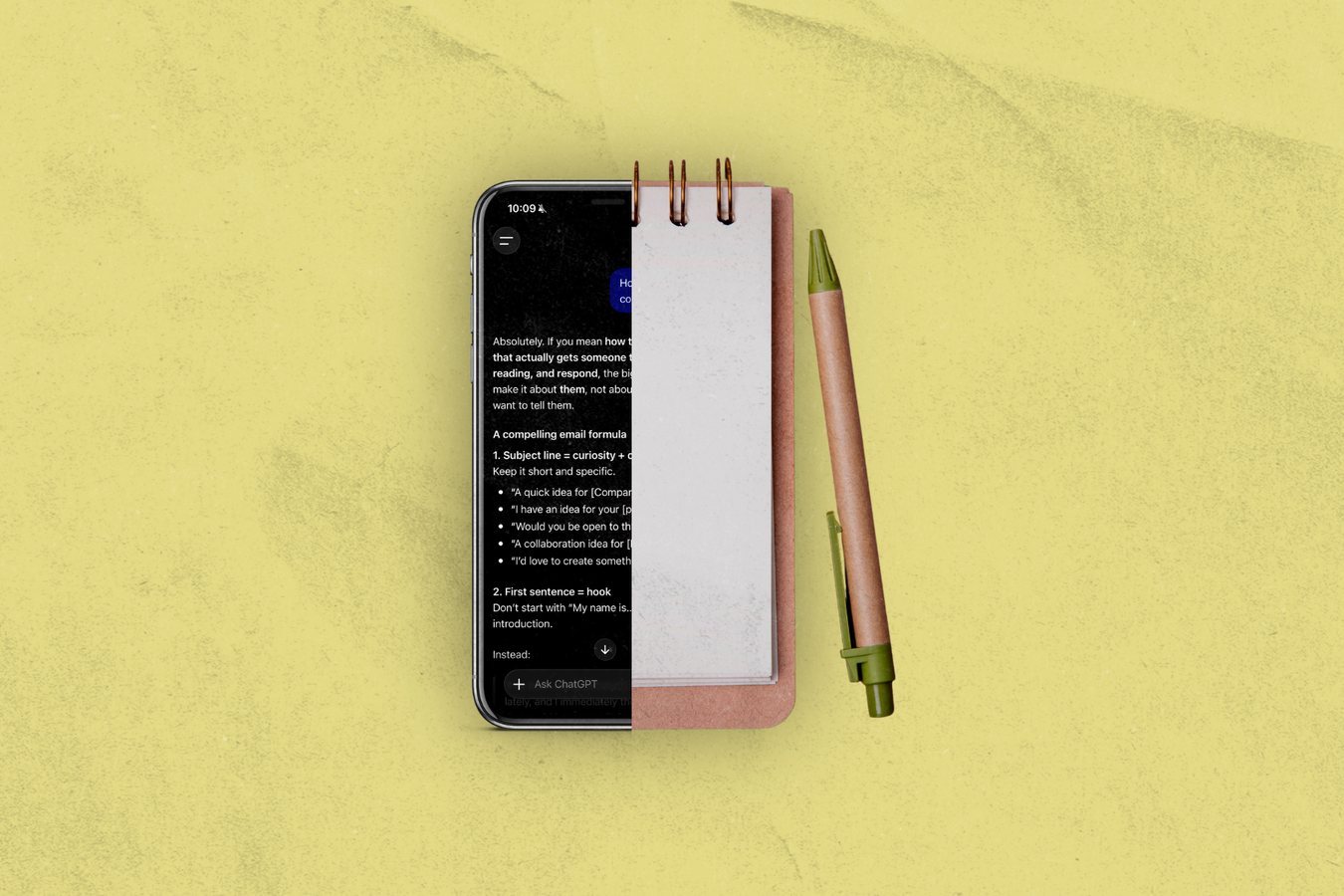
Researchers who study creativity are urging people to write down three of their own ideas before asking an AI chatbot for help. The advice applies to small tasks like naming a houseplant or choosing a birthday gift, and to bigger ones like drafting a tricky email at work. The goal, experts say, is to think first, so that someone or something else does not supply the answer before you have tried.
Neuroscientist Adam Green, a professor of psychology at Georgetown University who studies creativity, recalled a college student who shared a home with roommates and got a new basil plant. The group wanted to name it together, but one roommate turned to ChatGPT for suggestions. Green said that missed the point of the activity. Coming up with a name themselves would have given the roommates a shared memory and a story to tell about the plant. Instead, he said, « we just lost this experience ».
Green said the pull toward AI is understandable. « We’re all scared of the blank page, » he said, « and AI is offering to fill that page for us and take that fear away. » But working through that discomfort brings its own rewards, including the satisfaction of figuring something out, expressing something meaningful, or realizing you can do something difficult. Relying on AI to skip that struggle can make it harder to generate your own ideas later.
Sabrina Habib, a creativity researcher at the University of South Carolina, said AI tools offer « a narrow set of possibilities », which can lead to what researchers call anchoring or fixation. Once you have been handed that narrow set, she said, it becomes harder to think beyond it. Green and his colleagues compared human-written college admissions essays with ones generated by ChatGPT. The human essays explored a wider range of ideas, while the AI essays covered much of the same ground. « When we adopt AI’s ideas as our own, our own ideas become similar to each other, » Green said. « We lose our unique voice. »
Experts also point out that people hold knowledge a chatbot does not. Only you know the inside joke that belongs in a sister’s birthday card or what would make an overworked colleague’s day easier. Habib said that bringing your own thoughts keeps you in charge and makes you the author. AI can help build on what you have started, she said, but « humans have to be in control of the vision, the direction. »
To build the habit, Habib suggests first clarifying what you need. For a gift, ask what would make it a good one for that particular person. For a heavy workload, ask what would actually take something off your plate. Those criteria help you generate possibilities and later judge whether AI’s suggestions are useful. Then write three options, such as three gifts your sister might like, three ways to adjust your workload, or three points for a difficult conversation.
Erica Dhawan, a digital communication expert and author of the forthcoming book Use Your Brain, calls this the « naked draft rule »: write your own raw draft before using AI. The draft does not need to be polished. It can have an awkward opening or an idea you will later delete. Getting thoughts down gives you something to revise, build on or cross off. If three ideas come easily, Habib suggests trying five.
If nothing comes, Habib advises against treating the blank page as proof that you have lost the ability to think. She suggests giving yourself permission to find the task hard, setting a three-minute timer and writing everything that occurs to you, with one idea per sticky note, or taking a walk and returning to the problem later. Whatever the count, she said, be patient with yourself. « Even if it takes time, I’m capable. I can do this. »
Once you have a draft, you may find you do not need AI. If you do want help, Aron Lindberg, a professor of information systems and analytics at Stevens Institute of Technology, suggests giving the tool your own ideas and the details that inspired them. Asking a chatbot what to buy your sister without telling it anything about her, he noted, is likely to produce generic results.
4

Source: This Simple Rule Can Keep AI From Doing All Your Thinking