Memorandum
- From
- Caroline Mercer via FOX News
- Date
- Filed
- Politics·5 min to read
- Re
Trump Signs Greenland Security Pact as Xi Visit Puts Arctic Rivalry in Focus
ReTrump Signs Greenland Security Pact as Xi Visit Puts Arctic Rivalry in Focus
President Trump signed a Greenland security agreement barring non-NATO military presence one day before hosting Chinese President Xi Jinping, sharpening the Arctic backdrop to their Washington talks.
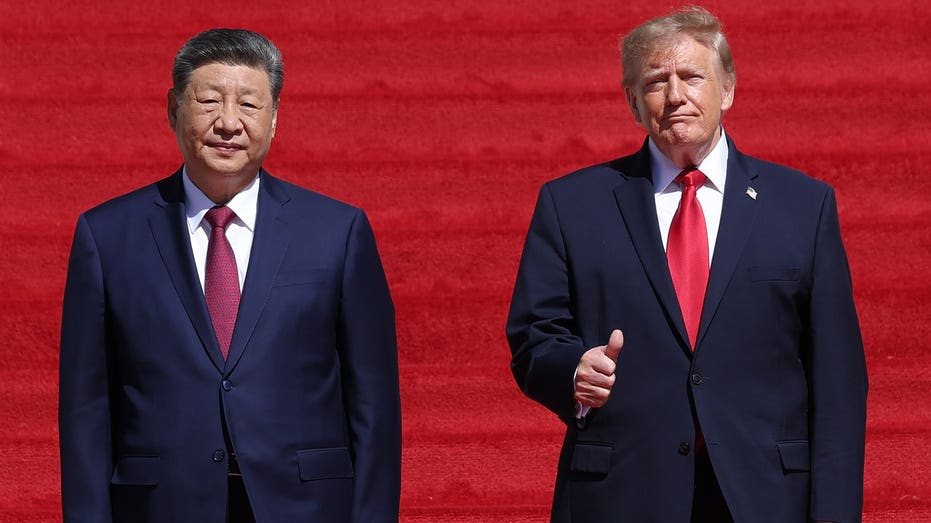
President Donald Trump signed a Greenland security agreement that would bar non-NATO states such as China from establishing a military presence in the territory, one day before welcoming Chinese President Xi Jinping to Washington for a three-day state visit that placed Arctic competition at the center of their face-to-face talks.
The agreement, formally signed Sept. 22, expands the U.S. military position in Greenland while restricting Chinese military activity and certain sensitive investments there. Once in force, it would give the United States and NATO allies a first right of refusal on mining rare earth elements, oil, gas and data centers, according to Christine Balling, senior vice president for professional affiliations at The Institute of World Politics.
Balling called the deal a major strategic victory. She said it secures land, air and sea rights across Greenland and allows the United States to establish two additional bases, building on an existing Space Force installation. «Number one, that is a tremendous victory for the United States and frankly, the free world,» she said. «It means that the United States has the ability to establish two more bases at present.»
Xi's visit unfolded against that backdrop. Trump hosted a formal White House arrival ceremony, held high-stakes talks, joined Xi for a tour of the National Archives and presided over a state dinner attended by 134 guests, including prominent technology executives such as Jensen Huang of Nvidia, Mark Zuckerberg of Meta, Lisa Su of AMD, Tim Cook of Apple, Sam Altman of OpenAI, Elon Musk of Tesla and SpaceX, Jeff Bezos of Amazon, Satya Nadella of Microsoft and Sundar Pichai of Google.
A senior U.S. official said Trump and Xi discussed the economy, trade, «Super Intelligence» and cooperation on a range of shared priorities, though it remained unclear what concrete agreements emerged from behind closed doors. Trump has so far stopped short of announcing a concrete agreement from Xi's Washington visit, a contrast to his May trip to Beijing, when he told reporters before leaving China that the two countries had made «some fantastic trade deals,» even though the White House did not release its full economic deal package until two days after the summit.
Balling said inviting America's top artificial intelligence executives to the state dinner was a strategic move to show Xi that the United States leads the global AI race. «I think the significance of the timing of this meeting, whether it's intentional or not, shows that the Trump administration is taking the future of AI and the world very, very seriously,» she said. «But the bottom line is, I think the most important images were those of all of the AI techs who were invited to that state dinner.»
Greenland has emerged as a recurring backdrop to Trump's two meetings with Xi this year. Negotiations over an expanded U.S. security role there began months before Trump traveled to Beijing in May, and Trump renewed public pressure over Greenland during the summer as his administration continued talks aimed in part at limiting Russian and Chinese influence in the Arctic. Five days before Xi arrived in Washington, Trump announced the security agreement.
China has long sought a larger Arctic role, declaring itself a «near-Arctic state» and promoting a «Polar Silk Road» encompassing commerce, research and resource development. Beijing has shown interest in Greenland's infrastructure and natural resources, including rare earth and critical mineral deposits. U.S. officials have pointed to past Chinese efforts involving a former U.S. naval base and airport projects as signs of broader ambitions in the region.
Balling argued that Beijing had reason to oppose the U.S.-Denmark-Greenland agreement because the United States remains heavily reliant on China for several critical-mineral supply chains. She also dismissed critics of Trump's earlier talk about buying or invading Greenland. «I also have to say for all of those who were mocking the Trump administration and President Trump's talk about buying or invading Greenland, they have an egg on their faces now,» she said. «I never for a moment thought that President Trump was serious about this. I think that what he was serious about, was exactly what was achieved in the agreement that was just signed.»
4