
Memorandum
- From
- Caroline Mercer via TIME.com
- Date
- Filed
- Politics·5 min to read
- Re
Trump's Approval Hits 32% as Iran War and Economic Strain Test His Presidency
ReTrump's Approval Hits 32% as Iran War and Economic Strain Test His Presidency
In a wide-ranging Oval Office interview, President Trump acknowledged his political standing has weakened as the Iran war drags on, inflation persists, and Republicans brace for midterm losses.
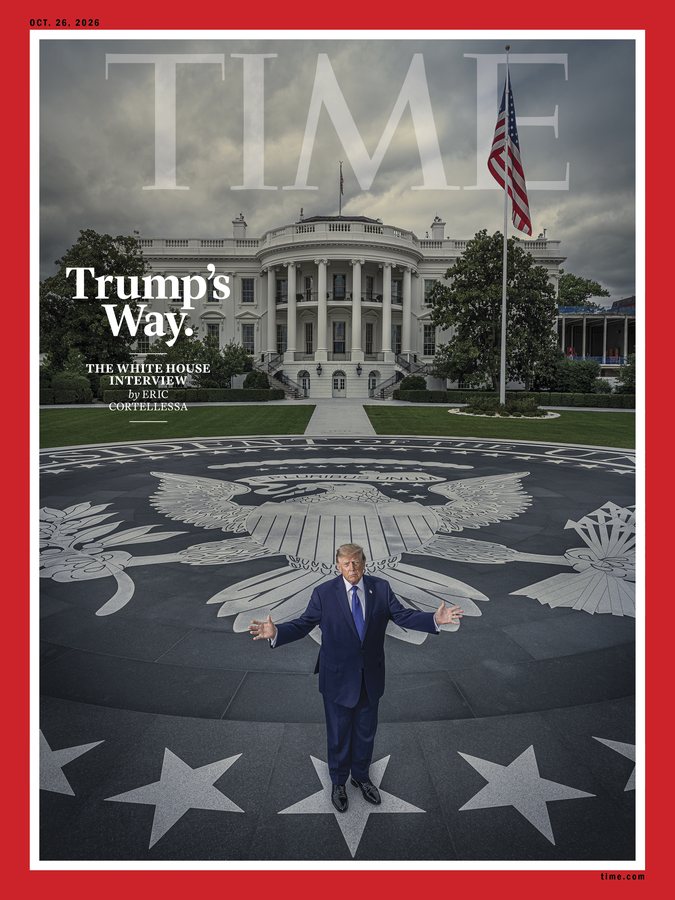
President Donald Trump's approval rating has fallen to 32%, the lowest of his political career, as an unpopular war with Iran, rising inflation, and growing economic anxiety erode his standing with voters and fracture the coalition that returned him to power, according to a Reuters/Ipsos poll conducted in September.
The finding, reinforced by a Wall Street Journal survey showing Trump with the lowest ratings of any president heading into midterm elections since 1990, comes as senior advisers inside the administration increasingly recognize that he has passed the peak of his second-term influence. Republican officials across the country are preparing for the likelihood of losing the House, and possibly the Senate, in the midterms.
In a 75-minute Oval Office interview, Trump was discursive and grievance-fueled, veering from the crises of his presidency to old and emerging resentments. He expressed regret over appointing Neil Gorsuch, Brett Kavanaugh, and Amy Coney Barrett to the Supreme Court after they ruled against him on tariffs, mail ballots, and birthright citizenship. «I gave them the position of a lifetime,» he said, «and they voted against me often.» On his expectation of loyalty, he was unapologetic: «I do like loyalty, yeah.»
The war in Iran, launched without congressional authorization and initially described by Trump as a four-to-six-week undertaking, is now seven months old with no end in sight. It has sent oil and gasoline prices soaring and convulsed the global economy. Inflationary pressures compounded by Trump's tariffs have pushed the Federal Reserve, now led by his handpicked chairman, to raise interest rates over his objections, with another hike possible before year's end. Mortgage rates have climbed to 7.5%, worsening an already punishing housing market.
The political coalition that returned Trump to power has frayed, with signs of discontent among independents, rural voters, and parts of the Latino electorate, even as his GOP base remains substantially loyal. Republican candidates have distanced themselves from his military actions and his deportation campaign. Voters have recoiled at his laissez-faire approach to the artificial intelligence industry and his accumulation of wealth while in office through crypto deals, thousands of disclosed stock trades, and an expanding empire of Trump-branded developments stretching from Saudi Arabia and Qatar to India and Vietnam.
Democratic control of Congress would bring investigations and subpoenas, hearings, and potentially a third round of impeachment proceedings. Cabinet officials could be hauled before Congress. Trump described the prospect in characteristic terms. «They'll probably go after me,» he said, «and I'll go after them.»
Yet with so much at stake, Trump can seem curiously preoccupied. Again and again during the interview, he returned to the condition of the White House itself, complaining that his predecessors had left the building in disrepair and deriding Barack Obama as someone who «doesn't know if something's dirty or clean.»
He has busied himself with construction projects he can control. A new 80,000-square-foot helipad of carved granite now occupies the South Lawn, its gray stone imported from Italy and fitted together in five sections with measurements Trump says are precise to an eighth of an inch. Behind it rises a new White House ballroom, its concrete skeleton consuming the former East Wing. Lawsuits have followed, alleging that Trump demolished the historic structure and began building its replacement without congressional authorization or required federal reviews. He kept building anyway.
Trump points to the walls, calling them «nuclear concrete» and describing a military complex beneath the ballroom that will plunge six stories underground. There will be five separate floors, he says, with one side made entirely of glass, 6 or 8 inches thick. «The steel goes up next week,» he said. As he walked toward the Oval Office, he stopped several times to inspect his handiwork: freshly painted doors, new gold doorknobs, the Rose Garden lawn ripped out and replaced with a Mar-a-Lago-style patio where he now presides over dinners at what he calls the Rose Garden Club.
«People say, why do you spend so much time on this?» he said. «But I find it relaxing.» Later, he returned to the subject again. «It's what I do best,» he mused aloud. «I say, am I a better builder or a politician?»
Trump also dismissed widespread opposition to the rapid build-out of data centers, including among his own base, as a prescription for a poorer America.
4