
Memorandum
- From
- Connor Quincy via PBS NewsHour
- Date
- Filed
- News·5 min to read
- Re
DHS Secretary Mullin Threatens Penalties for States Refusing Voter Data Access
ReDHS Secretary Mullin Threatens Penalties for States Refusing Voter Data Access
Homeland Security Secretary Markwayne Mullin threatened fines, penalties, or prison time for state election officials who refuse to hand over sensitive voter data to DHS, as part of a new election security crackdown following President Trump's address to the nation.
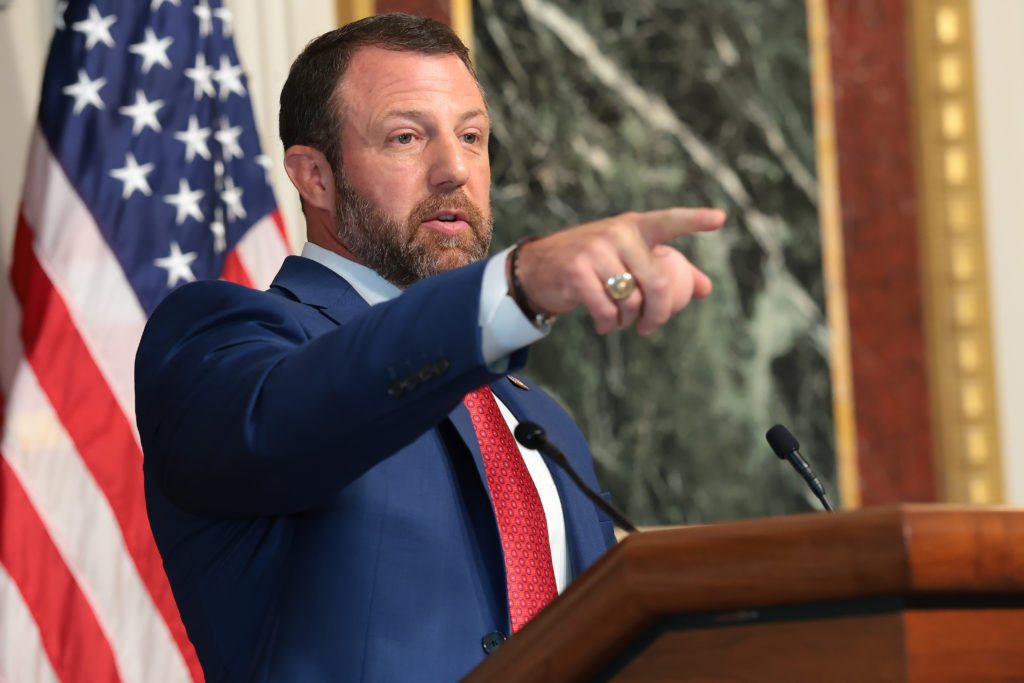
Homeland Security Secretary Markwayne Mullin on Friday threatened fines, penalties, or prison time for state election officials who refuse to hand over sensitive voter data to the Department of Homeland Security, escalating the Trump administration's push for stricter election security measures. The warning came during a White House news conference where Mullin doubled down on President Donald Trump's claims about widespread vulnerabilities in the nation's election infrastructure.
Mullin's remarks followed Trump's roughly 25-minute address to the nation on Thursday evening, during which the president announced the declassification and release of intelligence he said revealed «shocking vulnerabilities» in election infrastructure. Trump alleged that China had acquired 220 million U.S. voter files starting during the 2020 election cycle, calling it «the largest compromise of election data in history.» The White House subsequently posted materials on China's acquisition of American voter data, electronic voting systems, a Michigan voter-registration investigation, and non-citizens on state voter rolls.
In his news conference, Mullin specifically notified election officials in California, New Jersey, Nevada, and Pennsylvania that DHS had identified more than 250,000 potential non-citizens on those states' voter rolls. The department claimed that the data showed a staggering number of non-citizens registered to vote, with California alone potentially having 190,000 such registrations. Mullin warned that state officials who refuse to cooperate with federal requests for voter data could face legal consequences, including fines, penalties, or imprisonment.
The crackdown comes as the Trump administration seeks to push Congress to pass the SAVE America Act, which would require photo identification and proof of citizenship for federal elections and sharply restrict mail voting. The measure passed the House in February but stalled in the Senate in March when a 53-47 vote fell short of the 60 votes required to advance it. Trump used his address to urge lawmakers to pass the legislation, calling it essential to addressing what he described as a crisis in election security.
However, the president's claims have faced significant pushback from Democrats and some media outlets. Sen. Mark Warner, D-Va., the top Democrat on the Senate Intelligence Committee, clashed with CBS News anchor Tony Dokoupil during a live special report after Trump's address. Warner accused the network of presenting disputed election claims without enough pushback, saying he was «embarrassed that the President of the United States went before our whole country, and networks like yours carried this as news, as opposed to a rehash of falsehoods.» Dokoupil defended CBS's coverage, noting that the network had brought Warner on specifically to scrutinize the president's assertions and had provided fact-checking and analysis throughout its broadcast.
CBS later published a fact check characterizing Trump's claim about China's acquisition of voter data as misleading, noting that much voter information is public and citing a 2020 CISA-FBI bulletin that said acquiring voter-registration data did not affect voting or election results. The network also challenged Trump's allegations about voting machines, non-citizens, and mail ballots. Other networks, including ABC, NBC, and CNN, chose not to air Trump's primetime address live.
Mullin's threat of legal action against state officials marks a significant escalation in the federal government's efforts to assert control over election administration, traditionally a state-led function. The move is likely to face legal challenges from states that argue the federal government is overstepping its authority. Election security experts have also raised concerns that the administration's claims could undermine public confidence in the electoral process without providing evidence of widespread fraud.
The controversy over election security is expected to remain a central issue in the lead-up to the November midterm elections, with both parties using the debate to mobilize their bases. Democrats have accused the Trump administration of using unsubstantiated claims to justify voter suppression, while Republicans argue that stronger measures are needed to protect the integrity of the vote.
117