
Memorandum
- From
- Connor Quincy
- Date
- Filed
- Economy·7 min to read
- Re
Why Taiwan's NT$1.1 trillion defense plan matters economically
ReWhy Taiwan's NT$1.1 trillion defense plan matters economically
A proposed 16% rise in 2027 would lock in defense spending above 3% of GDP and deepen a multi-year investment cycle spanning imported weapons and domestic industry.
Taiwan’s proposed 2027 defense increase is best understood as a fiscal shift, not simply a military headline. Reuters reported that the Cabinet plans to raise the broad, NATO-style measure of defense-related spending by about 16%, pushing it above NT$1.1 trillion for the first time. The government is expected to present the proposal on Aug. 20, giving lawmakers and businesses their first detailed look at how the additional resources will be divided.
The starting point is already substantial. Taiwan’s Ministry of National Defense says the 2026 NATO-standard total is NT$949.5 billion, or 3.32% of GDP. That figure includes veterans’ retirement payments and Coast Guard expenditures in addition to the MND’s own NT$806 billion budget. Using the broad number matters because it prevents an apples-to-oranges comparison between military appropriations and the larger national-security aggregate.
The economic significance is the creation of a durable spending floor. The MND says it aims to keep defense expenditure at no less than 3% of GDP while maintaining steady and sustainable growth. A commitment of that kind changes planning for contractors, suppliers and public finances. Multi-year weapons programs, production lines and training systems become easier to sustain when they are supported by a predictable budget rather than short-lived emergency funding.
The government’s earlier special-budget proposal shows where some of that investment could flow. For 2026 through 2033, the MND outlined a program with an estimated ceiling of NT$1.25 trillion. The categories included precision artillery, long-range strike missiles, air and missile defense, anti-armor weapons, unmanned platforms, counter-drone systems, sustainment equipment, AI-assisted systems and C5ISR. The plan also explicitly linked defense spending with strengthening domestic industry and building supply chains less dependent on China.
That creates two different economic channels. One is foreign procurement, particularly from the United States. In May, Taiwan’s legislature approved a separate framework capped at NT$780 billion for U.S. military equipment. The other is domestic production and commissioning, including projects that were not fully captured by that narrower legislation. The balance between the two will shape how much of the spending circulates through Taiwan’s own industrial base.
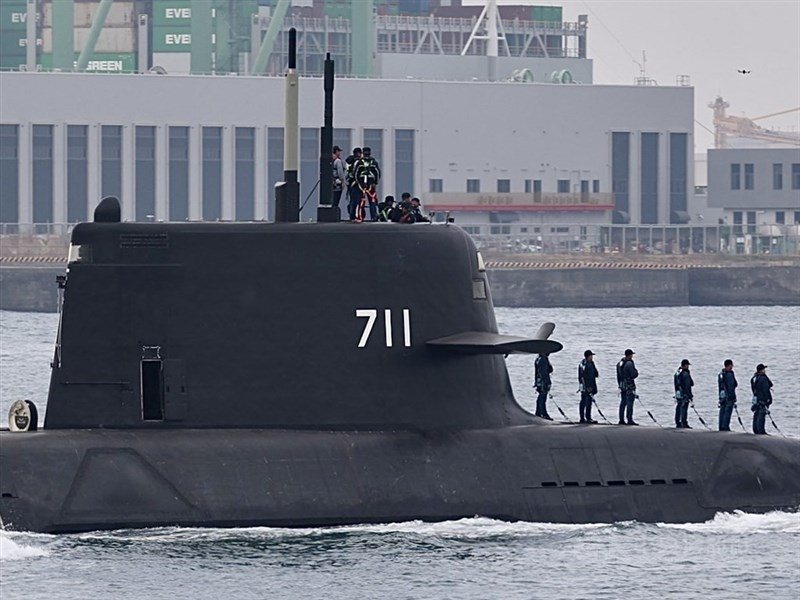
The indigenous submarine program illustrates the domestic-capability approach. Official budget documents envisage seven follow-on submarines after the Hai Kun prototype, with a total project budget of NT$284.0808 billion through 2038. Such a program creates long-duration demand for shipbuilding, electronics, systems integration, testing, maintenance and specialized labor. It is expensive, but it also accumulates industrial knowledge that cannot be replicated through a one-time purchase abroad.
There are also less visible economic costs embedded in resilience. Taiwan’s defense planning emphasizes ammunition stocks, spare parts, communications backups and the ability to keep equipment operating after infrastructure is damaged. From a peacetime efficiency perspective, redundancy can look wasteful. From a security perspective, it is an insurance premium against disruption. The budget increasingly reflects that trade-off.
The strategic driver is Taiwan’s assessment of sustained military pressure from the People’s Republic of China. The MND says varied PRC activities have compressed warning times. Beijing, for its part, says Taiwan is part of China and rejects actions it describes as separatist. This persistent political dispute means Taiwan’s fiscal decisions are being made under a risk environment in which the potential cost of underinvestment is perceived as exceptionally high.
That does not make every defense dollar economically productive. Procurement delays, political disputes, foreign export approvals and technical failures can all reduce the value of appropriations. Lawmakers already demonstrated their ability to reshape plans when they adopted the NT$780 billion U.S.-arms framework rather than the government’s broader original concept. The Aug. 20 proposal will therefore be the beginning of a budget process, not its final outcome.
The most informative numbers will be underneath the NT$1.1 trillion headline. How much goes to investment rather than personnel? How much supports domestic manufacturing? How much is committed to long-term special projects? And how much is tied to Coast Guard and veterans’ obligations? Those answers will determine whether the 2027 increase functions mainly as a larger security bill or as a structural expansion of Taiwan’s defense-industrial economy.
Either way, the direction is clear. Taiwan is moving toward a model in which security spending occupies a permanently larger share of national resources. The economic question is no longer whether defense will be expensive. It is whether the government can use that expense to create credible deterrence, resilient supply chains and industrial capacity without allowing procurement inefficiency to consume the gains from a larger budget.
The timing of payments will also matter. A headline appropriation can support contracts whose cash outlays stretch over a decade, creating future liabilities that are not obvious from a single-year total. Economists and investors will therefore need to distinguish between authorized program value, annual disbursement and the domestic share of each contract. Those differences will shape the effect on public finances, suppliers and Taiwan’s broader capital allocation.
There is a labor-market dimension as well. Local defense production competes for engineers, software specialists and advanced manufacturing talent with Taiwan’s civilian technology sector. If the government succeeds in expanding domestic capacity, wages and hiring pressure could rise in specialized fields. That would be a sign that the defense buildup is becoming embedded in the wider economy — and another reason why the composition of the 2027 budget matters more than the record total alone.
61