
Memorandum
- From
- Caroline Mercer via UX Collective
- Date
- Filed
- Economy·4 min to read
- Re
Tesler's Law Persists as AI Chat Interfaces Shift Complexity to Users and Teams
ReTesler's Law Persists as AI Chat Interfaces Shift Complexity to Users and Teams
Larry Tesler's law of conservation of complexity remains relevant in the age of AI chat interfaces, as the burden of specifying and verifying outputs moves to users and development teams, often without clear measurement.
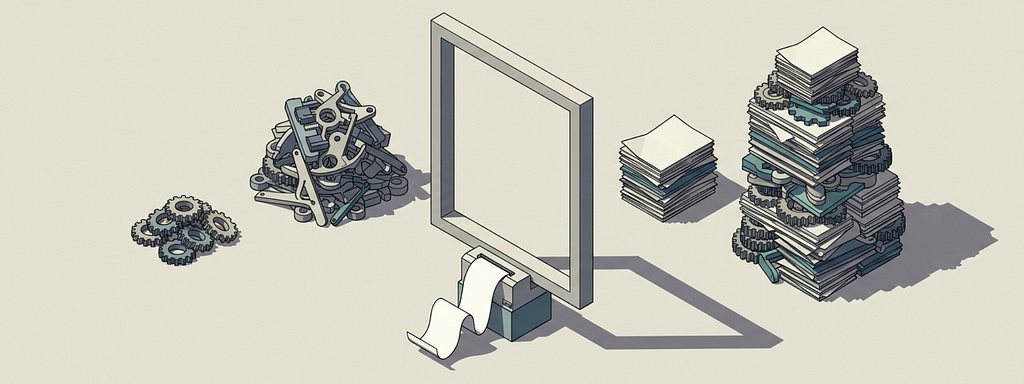
The complexity of software never disappeared with the rise of AI chat interfaces; it simply moved to different parts of the user journey, according to a new analysis of Larry Tesler's law of conservation of complexity. Tesler, the computer scientist who pioneered cut, copy, and paste at Xerox PARC in the 1970s and later became Apple's chief scientist, argued that every application has an inherent amount of irreducible complexity that cannot be eliminated, only transferred among the user, the developer, or the system.
That principle, formulated in the mid-1980s, is now playing out in the design of AI-powered chat boxes. The chat field appears to remove menus, modes, and manuals, but it actually redistributes the hard parts of a task in three directions at once. Some complexity moves into the model itself, which represents genuine progress. Some shifts onto the user, who must now write detailed specifications and judge the quality of the output. The rest lands on development teams, which take on evaluation work that few organizations have staffed or budgeted for.
The result is a new ledger of who pays for simplicity. In the past, users learned menus and shortcuts; developers handled conditional logic and error messages; platform providers like Microsoft or Apple controlled release cycles. Today, users write instructions and review results, developers manage evaluations and retrieval plumbing, and model providers change their systems every few weeks without notice. A new role has also emerged: the reviewer, who certifies output that no one in the room produced.
This transfer of complexity is not inherently a failure, the analysis notes. Moving difficulty is the job of design. The problem is that the transfer is often concealed, leaving no mark on the interface where the burden landed. As a result, the savings from AI features look free, even though they show up elsewhere as review time, evaluation hours, and inference costs. Almost nobody counts both ends of the transfer, which is why the true cost remains invisible.
The text box itself is a case in point. Unlike a dropdown that teaches the domain while constraining choices, or a disabled button that reveals a rule, a blank text field offers no clues about what belongs inside it. Users can learn which prompts work, but the burden sits with every user. Writing a specification used to be a professional skill with training and review; it is now the control surface for hundreds of millions who never asked for the job.
Empirical evidence supports the concern. In July 2025, METR ran a randomized controlled trial with 16 experienced open-source developers across 246 tasks in repositories they had maintained for years. The result was a 19 percent slowdown when AI was allowed, even though developers had forecast a 24 percent speedup. The gap between expectation and reality highlights how verification and specification costs can outweigh the time saved by automated generation.
Tesler's law has not been repealed. The question is not whether complexity can be removed, but who will deal with it and whether that transfer is measured. As AI interfaces become more common, the organizations that thrive may be those that instrument both the sending and receiving ends of the complexity transfer, making the full cost visible and manageable.
5