
Memorandum
- From
- Connor Quincy
- Date
- Filed
- Culture·4 min to read
- Re
Spotify’s AI Persona Rule Separates Identity From AI-Assisted Art
ReSpotify’s AI Persona Rule Separates Identity From AI-Assisted Art
The platform will stop recommending fictional AI artists by default while keeping a separate path for human musicians who use AI as one tool in the creative process.
The most useful way to understand Spotify’s new AI Persona policy is to separate two questions that are often collapsed into one. The first is whether artificial intelligence was used to help make a song. The second is whether the “artist” presented to listeners is a real person at all. Starting in mid-September, Spotify will treat those questions differently.
Profiles built around a fictional, AI-generated artist identity will receive an “AI Persona” label. By default, music from those profiles will be excluded from personalized recommendations and editorial selections. The profile itself will remain available, so listeners can search for the act, play the music, and choose to follow it. The change affects passive discovery, not the basic ability to listen.
There is no announced Premium paywall attached to that choice. Reporting on the rollout says an AI Persona can re-enter a listener’s recommendation orbit when that listener actively follows the account. Spotify’s own support documentation says following artists helps improve recommendations. The practical shift is therefore from algorithmic introduction to user opt-in.
That is different from Spotify’s treatment of human artists who use generative tools. A musician can employ AI for a lyric, a vocal element, an instrumental performance, or production and still be treated as a real artist. Spotify’s AI credits system, currently in beta, is designed to disclose those contributions at the track level. It does not turn the entire song into a single “AI” category, and it does not place an AI Persona label on the artist profile.
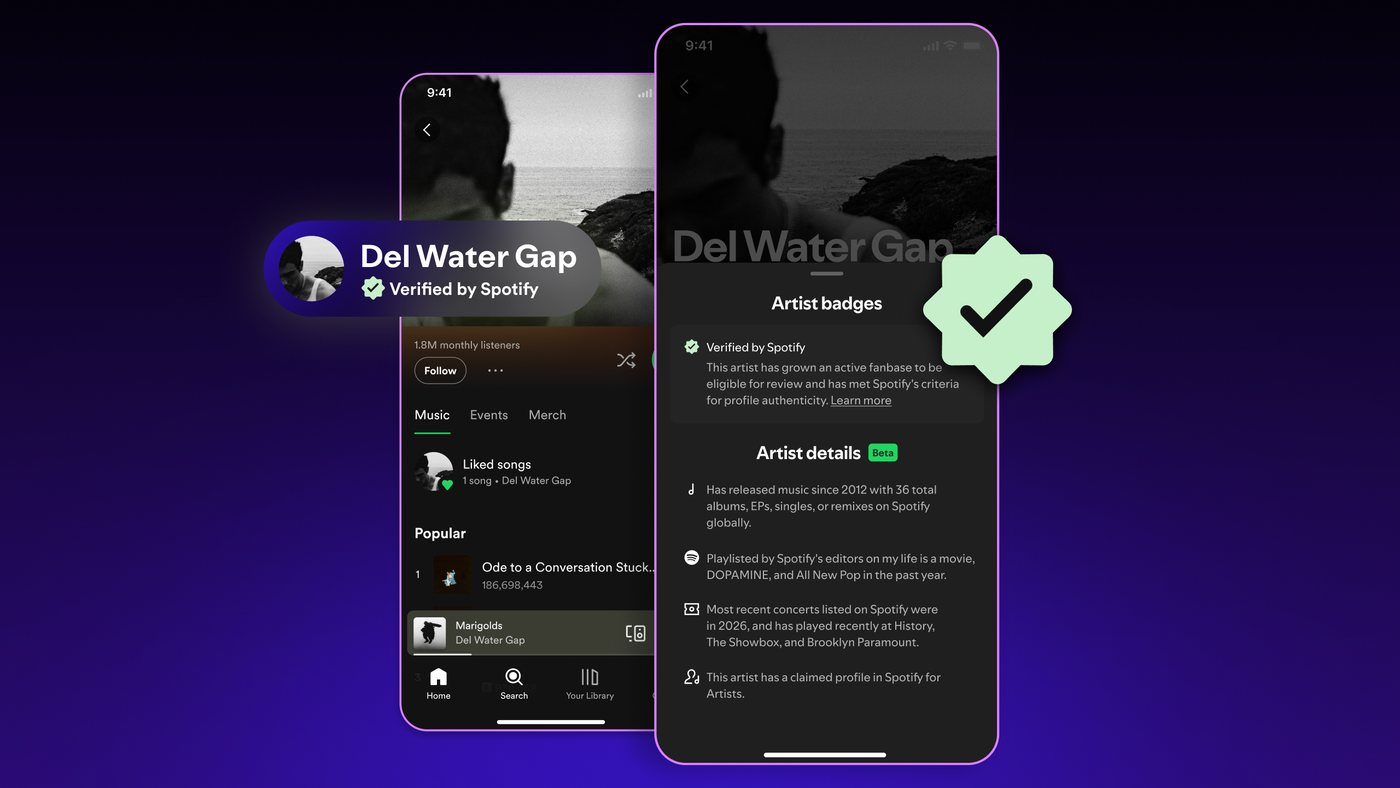
The same distinction appears in the company’s verification system. Spotify launched “Verified by Spotify” in April as an authenticity signal for artist profiles. Profiles that primarily represent AI-generated or AI-persona acts are not eligible. Real artists who responsibly use AI in their creative work can be. In other words, the platform is trying to reward transparency about identity without pretending that modern production can be divided neatly into human and machine camps.
Enforcement will involve more than self-reporting. Creators can declare an AI Persona themselves, but Spotify also plans to review prominent profiles using human reviewers and AI tools. Photorealistic synthetic identities are among the signals it can examine. Where evidence is suggestive but not conclusive, Spotify may display a “Likely AI Persona” marker, and affected artists can appeal.
The policy also sits beside stricter rules for outright deception. Spotify removes music that uses an unauthorized clone of another real artist’s voice. And in 2025 the company said it had removed more than 75 million spammy tracks in a 12-month period as generative tools made mass uploading cheaper and easier.
Those pieces form a layered policy rather than a single anti-AI ban. One layer protects identity from impersonation. Another lets artists disclose AI contributions to a song. Verification distinguishes real artist profiles from synthetic personas. The new recommendation rule changes how those personas gain exposure.
That structure may matter beyond Spotify. As generative tools become ordinary parts of creative work, the difficult question is less whether AI touched a recording and more whether listeners understand the relationship between the music, the named artist, and the people behind it. Spotify’s September change answers that question with an explicit label and a default: synthetic identities are allowed, but the algorithm will no longer introduce them without the listener taking the first step.
65

Source: The Verge on the distinction behind Spotify’s AI Persona policy