Memorandum
- From
- Connor Quincy via fox - World
- Date
- Filed
- Society·4 min to read
- Re
France's Student Protests Turn Violent as Budget Cuts Fuel Anger
ReFrance's Student Protests Turn Violent as Budget Cuts Fuel Anger
Violent student protests across France over school conditions and education funding have led to thousands of arrests and school closures, with some in the US calling the unrest a cautionary tale about immigration and social spending.
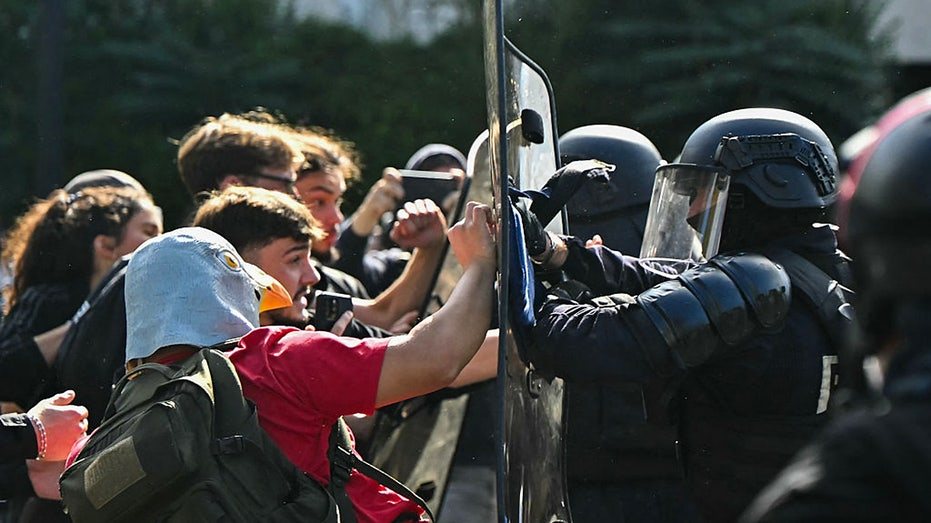
Violent student protests sweeping across France have led to more than 5,000 arrests and forced over 400 schools to close, as demonstrations over overcrowded classrooms and inadequate education funding escalated into widespread unrest. The protests, which began peacefully in Paris's poorer suburbs late last month, quickly spread to the capital and then to cities nationwide including Marseille, Strasbourg, Tours, Nantes, Toulouse, and Lille.
Students initially took to the streets to protest what they described as deteriorating school conditions, teacher shortages, and long school days, blaming the government for failing to invest sufficiently in education. The unrest intensified after the government unveiled its 2027 budget on Thursday, which showed education spending would rise by only 1.7 percent, excluding teacher pensions — an increase below the rate of inflation.
As the demonstrations expanded, they became increasingly violent. Rioters have committed arson and vandalism, thrown objects at police, and assaulted individuals in some cases. Authorities have responded with tear gas and rubber bullets. According to Euronews, at least 65 school staff members, including 40 principals, have been injured since the unrest began, along with roughly 170 students. More than 100 high schools have suffered what Education Minister Édouard Geffray described as «severe damage.»
French intelligence agencies told a government crisis meeting on Thursday that the protest movement had been initiated by politicians from the hard-left France Unbowed Party, known as LFI. The LFI has denied the allegations and accused President Emmanuel Macron's government of politicizing the protests ahead of France's 2027 presidential election.
The unrest has drawn attention in the United States, where some commentators are holding up the situation as a warning. «I would also say as we're sitting here in beautiful New York City, this is a cautionary tale,» said Tomi Lahren, co-host of «The Big Weekend Show,» on Saturday. She continued: «This is something we're learning from Europe, and we would be wise to learn from Europe. They decided they wanted to have open borders. They decided they wanted diversity as their strength, and of course, Joe Biden tried that for four years. We're undoing that currently.»
Lahren argued that when countries admit large numbers of immigrants, native-born citizens eventually grow upset, and that anger often becomes misplaced. «They end up lighting things on fire, which I think is stupid no matter what you're angry with, but it's no doubt these countries that say we're going to be a global home for everybody, they end up paying the price, and it's usually the native Frenchmen, or whenever they are that end up paying the highest price,» she said.
Simone Rodan-Benzaquen, senior envoy to Europe at the Foundation for Defense of Democracies, told Fox News Digital on Thursday that the unrest began with legitimate concerns but has since evolved into something far more serious. «The students' grievances about missing teachers and deteriorating schools were real at first,» Rodan-Benzaquen said. «But dousing a principal in gasoline and attacking firefighters are acts of extreme violence. What makes this politically significant is the effort to turn frustration over schools into a much broader confrontation with the government.»
The protests have also fueled political tensions in France, with the government pointing fingers at the hard left while the opposition accuses the administration of using the crisis for electoral gain. The coming weeks will test whether the government can address the underlying grievances before the unrest spreads further.
4