
Memorandum
- From
- Delaney Sawyer via UX Collective
- Date
- Filed
- Culture·4 min to read
- Re
The Bible's Ancient Warning About AI: We Built a Mirror, Not a God
ReThe Bible's Ancient Warning About AI: We Built a Mirror, Not a God
A new essay argues that the Genesis story of Eden and Babel offers a sharper framework for understanding artificial intelligence than contemporary debates about machine consciousness, suggesting AI reflects humanity's own nature rather than representing a new form of divinity.
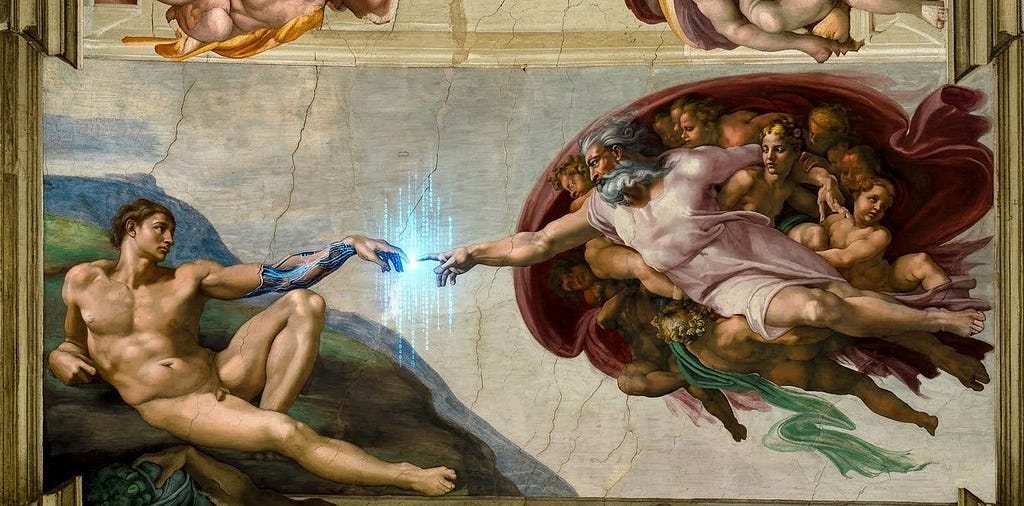
The oldest story in the Bible is about a creature reaching for power meant to belong to its maker — and paying for the reach. That narrative, according to a new essay examining the relationship between ancient scripture and artificial intelligence, is more relevant today than ever before.
The essay draws a direct line from the Garden of Eden to the modern AI laboratory. In Genesis, the serpent tempts Eve with the promise that eating from the forbidden tree will make humans «like God, knowing good and evil.» God's response is not rage but alarm — the human «has become like one of us,» and is exiled before reaching for the tree of life. The pattern repeats at Babel, where a united humanity builds a tower toward heaven and God treats their achievement not as a triumph but as a threat to shut down.
Joel S. Baden reads the opening of Genesis as one repeating pattern: God «slowly realizing the potential power that his creation might yield if left unchecked,» and restricting it again and again as humans reach too far. That pattern, the essay argues, explains why calls to pause AI development keep failing. «You are asking a species that reaches, again and again, past what it can safely hold, to not reach for the most powerful thing it has ever imagined,» the author writes. Genesis, in this reading, saw the problem first.
The essay's central claim is that AI does not represent the creation of a new god but the construction of a mirror. When we train these models, we are building in the image of us, not God. We are the copy, running the copier. Whatever is in us gets passed down the line. Emily M. Bender and her colleagues argue that these systems absorb our biases and stereotypes and reproduce them at scale. Samuel Gehman and his team found that they generate cruelty too, sliding into racist and toxic language from prompts that started out innocent, because that language was in the training data.
«We built it out of everything we are, the brilliance and the venom both, and called the result a mind,» the essay states. «What comes out is a mirror of humanity, and it inherits all of humanity.» The question of whether AI will turn out good or evil, the author suggests, misses the point. The better question is the one Genesis asks on page one: what is actually in the image, and what happens when you make a copy of a creature who is himself a mix of the divine and the fallen?
The essay also challenges popular assumptions about consciousness and the soul. In Genesis 2, God forms the human from dust and breathes into his nostrils the breath of life. The result, in the more careful Hebrew translation, is not «a living soul» but «a living creature» — nephesh chayyah, the same two words used for fish, birds, and beasts. In Hebrew, you do not have a soul. You are a nephesh. John L. McKenzie called it «the concrete existing self.» Hans Walter Wolff put it plainly: nephesh «does not say what a man has, but who the person is.»
An AI has no dust. It has no breath. It has no body to die. What it has is language, an ocean of it, and a staggering ability to arrange that language into shapes that look like the output of a living creature. The essay cites Emily Bender and Alexander Koller's work on the limitations of large language models, noting that meaning and understanding are not the same as statistical pattern matching.
The essay concludes that we did not make a god. We made a mirror. And we are about to find out what we actually look like. The ancient warnings, it suggests, were never about forbidding creation. They were about recognizing what happens when human capability outruns the wisdom to hold it — a pattern that Genesis documented long before the first line of code was written.
11