
Memorandum
- From
- Derek Weston via Yanko Design
- Date
- Filed
- Culture·4 min to read
- Re
RHYTHM Digital Audio Player Rejects Smartphone Logic in Favor of Dedicated Listening
ReRHYTHM Digital Audio Player Rejects Smartphone Logic in Favor of Dedicated Listening
A from-scratch portable player built around a genuine ESS SABRE DAC, dual independent headphone outputs, and a physical rotary encoder aims to restore music listening as a single, uninterrupted task rather than a notification interrupted by alerts.
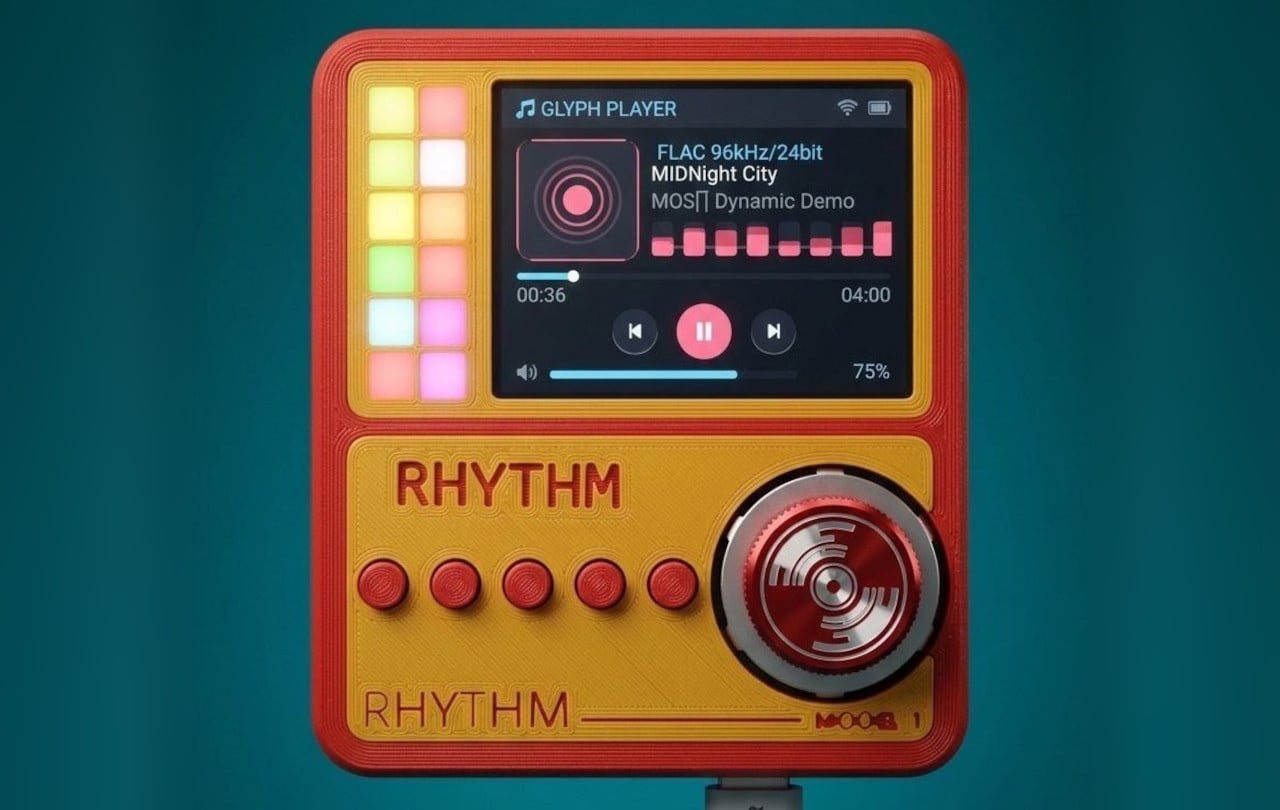
A new portable digital audio player called RHYTHM is making the case that music listening deserves its own device rather than a borrowed slot on a smartphone. The project, designed by Mithilesh Gupta Konda, is built from scratch around a single purpose: playing music properly, without a screen competing for attention or a notification interrupting an album.
The design argument starts with the audio path. Most budget players rely on an all-in-one audio codec chip, but RHYTHM routes sound through a genuine ESS SABRE DAC, the same category of component found in dedicated hi-fi equipment. That converter is paired with a discrete amplifier stage rather than a shortcut solution. An ESP32-S3 chip handles file parsing and processing, while the actual sound reproduction runs through hardware built specifically for that job alone.
The headphone output is where the device makes its clearest case. Instead of splitting one internal signal across a single jack, RHYTHM runs two completely independent, actively buffered 3.5mm outputs, each driven by its own dedicated amplifier chip. Two listeners can plug in two entirely different pairs of headphones and each receives a full, uncompromised signal, with no shared circuit quietly degrading whichever connection came second.
Keeping that signal clean required rethinking the power supply as much as the audio path. RHYTHM physically separates its digital logic and high-frequency switching lines from the analog circuitry that shapes the sound, regulating each side through its own dedicated, ultra-low-noise power regulator. It is an unglamorous decision that never shows up in a spec sheet screenshot, but it is the kind of choice that determines whether quiet passages in a recording stay quiet.
Physical control receives the same attention. A precision mechanical rotary encoder handles navigation alongside a set of tactile buttons, giving the interface a hands-on quality that a touchscreen cannot replicate. Paired with a compact 2-inch color display, the device reads less like a shrunken phone and more like a purpose-built instrument, something meant to be operated by feel in a pocket or a bag without needing to look at it.
A microSD slot rounds out the practical side, storing lossless files locally rather than depending on a streaming connection or an app ecosystem. That local-first approach extends the project's entire philosophy. RHYTHM is not trying to replace a phone's convenience. Instead, it opts out of that convenience on purpose, trading constant connectivity for a listening experience built around a single, uninterrupted task.
The device arrives as a deliberate counterpoint to how smartphones turned music into just another notification competing for attention, a song interrupted by a text, an album broken up by a calendar alert. RHYTHM exists to undo that arrangement entirely, building a dedicated listening device from real audio components instead of borrowing a phone's internals and bolting on a headphone jack.
Whether that philosophy finds an audience remains an open question, but the design stakes out a clear position: the hardware itself is the argument. Every choice, from the separate power regulators to the dual amplifier chips to the mechanical dial, points toward the same conclusion. A music player should do one thing, and it should do that thing without asking its owner to split attention between the song and the screen.
63