Memorandum
- From
- Connor Quincy via Fortune | FORTUNE
- Date
- Filed
- Business·4 min to read
- Re
Zoom and Financial Firms Adopt World's 'Proof of Human' Badges to Curb Deepfake Fraud
ReZoom and Financial Firms Adopt World's 'Proof of Human' Badges to Curb Deepfake Fraud
World, co-founded by Sam Altman, is bringing its iris-scan-based World ID verification to Zoom and major financial firms including Bain Capital and VanEck, adding blue badges that confirm a real person is behind the screen.
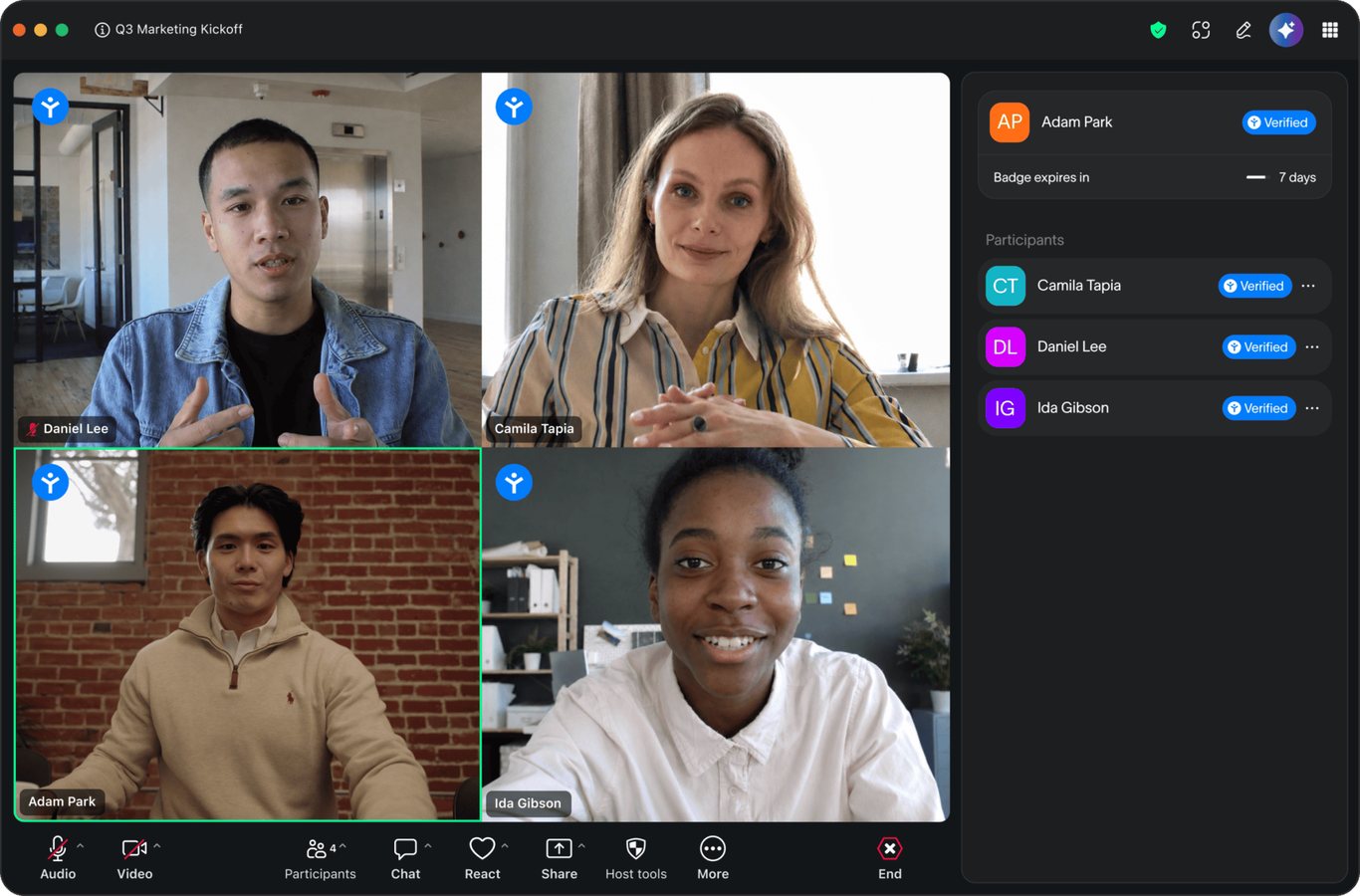
Zoom calls and sensitive financial transactions may soon come with a new kind of reassurance: a small blue badge confirming that the person on the other end is a verified human. World, the company co-founded by OpenAI CEO Sam Altman that operates the iris-scanning Orb device, announced Sunday that Zoom and several large financial firms are adopting its World ID verification tool to block malicious bots and deepfakes.
The integration is designed for high-stakes conversations, where fraudsters have increasingly used AI-generated video and audio to impersonate executives and trick employees into wiring money. Under the system, participants who have cleared World ID's checks appear on a Zoom call with a badge signaling both that they are human and that they are who they claim to be. Companies can decide when to require the verification, reserving it for sensitive calls rather than routine meetings.
World ID is built on iris scans captured by the company's Orb devices, which are roughly the size of a football. The scans create a permanent, tamper-proof record of identity, but World says the underlying cryptography does not produce a central database of individuals. Instead, the identity is encrypted in a way the company cannot read. When a user needs to verify on Zoom or another platform, they use a phone camera and an app that cross-checks against the encrypted Orb record.
The technology has drawn controversy, partly because of its biometric approach and partly because of its association with Altman. World's chief product officer, Tiago Sada, compared the rollout to Apple's introduction of Touch ID and facial recognition on the iPhone, features that were initially met with suspicion before becoming routine. He also stressed that the protocol is built on open-source code that anyone, including competitors, can use. «People understand you don't have to give Sam or any of us your photo … Everything is open source and auditable,» Sada said. He added that World ID uses blockchain technology for decentralization and encryption, and that while «90% of the crypto space is BS,» the remaining 10% is profound.
Beyond Zoom, World said financial firms including Bain Capital and VanEck Funds are adding the tool to their workplaces. A company spokesperson said the firms will keep Orb devices in their offices so employees who have not previously used one can scan their irises. Not every verification requires an eye scan: World ID offers three tiers through its app. The lowest, «Proof of Attributes,» verifies identity using scanned government documents. A middle tier, «Proof of Presence,» requires a selfie. The highest setting, «Proof of Human,» combines the World app and a selfie checked against the biometric record registered with the Orb.
The tiers reflect a broader shift as bots proliferate online, from video calls to dating apps to shopping. Some large companies, notably Amazon and JPMorgan, have already begun blocking bots altogether. Sada argues that such tactics may secure transactions but limit companies' ability to compete in agentic commerce, where AI agents act on behalf of users. To address that, World is offering tools that let users assign their verified status to a single trusted agent, an arrangement Sada likened to a power of attorney. Merchants could then treat that agent as the user's alter ego.
World, formerly known as WorldCoin, is not alone in pursuing credentials for trusted agents. In August, the online security firm Cloudflare announced its own agent ID tool and a dedicated wallet. For now, World's bet is that proving humanity will become a standard step before many online interactions, and that the blue badge on a Zoom screen will be one of the first places consumers encounter it.
4