
Memorandum
- From
- Connor Quincy via Fortune | FORTUNE
- Date
- Filed
- Business·6 min to read
- Re
Nvidia issues first-ever year-ahead forecast, projecting 70% revenue growth
ReNvidia issues first-ever year-ahead forecast, projecting 70% revenue growth
Nvidia stunned investors with its first-ever year-ahead forecast, projecting 70% revenue growth for fiscal 2028, far above analyst expectations. The company also reported quarterly earnings that crushed estimates, with CEO Jensen Huang citing surging AI demand and supply constraints.
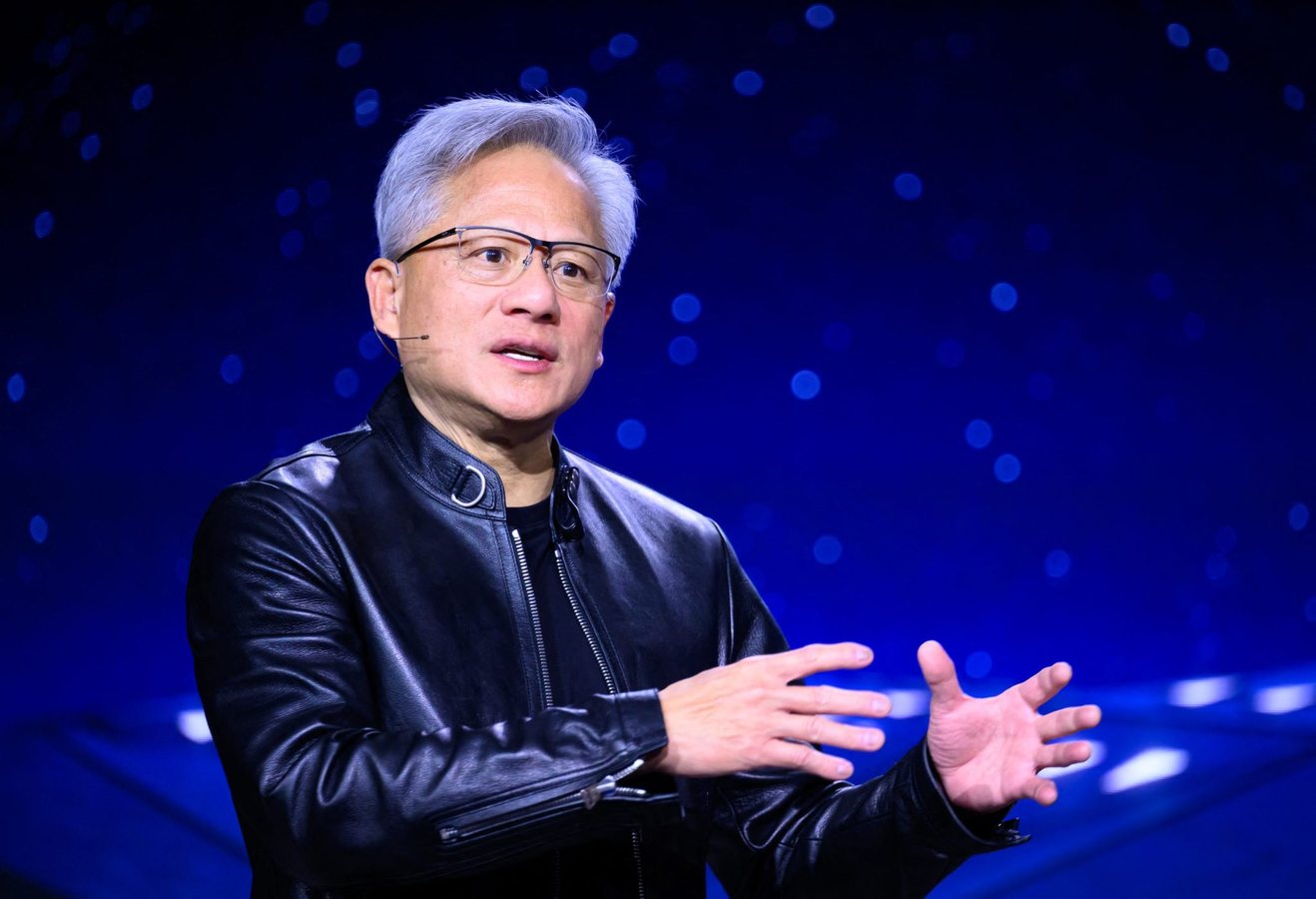
Nvidia jolted investors Wednesday with its first-ever year-ahead forecast, projecting revenue growth of roughly 70% for fiscal 2028 and saying demand for its AI chips is growing at 100%, prompting an after-hours stock rally. The preliminary expectation wildly exceeded analyst projections of about $570 billion in fiscal 2028 revenue, or 44% growth from the current fiscal year. Applied to expected fiscal 2027 revenue, Nvidia's projection implies fiscal 2028 revenue in the range of $690 billion to $700 billion, more than $100 billion above what Wall Street had been modeling.
CEO Jensen Huang said on a conference call that the company wanted to ensure everyone had the same information. «We've got a huge year coming up next year, and it's going to be pretty extraordinary,» he said. «It is the case that we've never forecasted, never guided to a year in advance,» Huang noted later. Melissa Otto, global head of Visible Alpha research at S&P Global, said the magnitude of top-line growth «blew away expectations,» especially given that Nvidia does not normally provide such guidance. «I think what wowed the market was that 70% fiscal year 2028 number that they gave that was way ahead of Visible Alpha consensus,» Otto said.
The forecast came alongside quarterly results that crushed across the board. Revenue for the second quarter came in at $96.2 billion, up 106% from a year ago and sailing past projections of $92.2 billion. The company earned $2.22 per share on a non-GAAP basis, above the $2.06 to $2.09 expected. Chief financial officer Colette Kress guided next quarter to $108 billion in revenue, matching the so-called buyside whisper range of $105 billion to $108 billion. Kress said customers' forecasts pointed to Nvidia's growth doubling next year, and her comments sent the stock rallying more than 4% in after-hours trading.
However, Nvidia is battling significant supply constraints, much like other mega-cap tech companies. «Our entire supply chain is challenged, and it's everybody; everybody is really running flat out,» Huang said. He added that if not for these constraints, revenue growth next year would be even greater. «Even though our demand is much greater than 70%, our supply allows us to confidently deliver 70%,» Huang said in response to an analyst question.
Huang said massive demand was coming from both hyperscale cloud providers and non-hyperscalers, including sovereign AI, neoclouds, AI startups, and enterprises. The non-hyperscale crowd «represents about half our business, and that's growing 100% a year,» he said. Much of the rising demand reflects a shift in how AI systems consume compute, particularly as agentic AI becomes more widespread. The amount of compute an AI agent uses versus a human user is about 15 to 100 times greater, depending on the task, Huang explained. «We have 40,000 employees, roughly,» he said. «In the future, we'll have 400,000 agents, 4 million agents, and those agents are running continuously.»
While booming demand has made Nvidia the world's most valuable company, with a market cap above $5 trillion, critics have warned about its spate of investments in other AI companies, from data center operators to frontier model makers like Anthropic. Many view the deals, financed from Nvidia's massive cash pile, as creating dangerous interdependencies. Kress offered a defense during the call. «We recognize the scale of this support, and we know some will call this circular financing,» she said. «We see it differently.» She said frontier AI labs have proven technology leadership, customer traction, and «skyrocketing» usage. «We expect them to become the largest technology companies in history,» Kress said. Their growth «isn't limited by their technology or customer demand. It's limited by compute.»
Nvidia disclosed maximum gross guarantee exposure of $108.5 billion, mostly stemming from credit support for SB Energy's Ohio tech campus, which will host Nvidia compute leased to OpenAI. The rest is due to $3.5 billion backing lease obligations for AI cloud partners. Nvidia has also publicized investments of nearly $50 billion in frontier AI labs and partnered with private equity giants Apollo, BlackRock, Blackstone, Goldman Sachs, and KKR to raise more than $500 billion in third-party capital for AI infrastructure. Kress said the investments were low-risk, high-reward. «We believe these investments, measured against the strength of their demand, the business they create for us, the ecosystem they build on Nvidia's platform, and the equity returns on our invested capital will be excellent, and our risk is limited,» she said. She added that demand from AI labs will contribute to about a quarter of Nvidia's business next year, and that Nvidia's platform is «fungible and durable» and can be used for other business if a partner alters its projections.
49