Memorandum
- From
- Delaney Sawyer via Fast Company
- Date
- Filed
- Business·3 min to read
- Re
Home prices fall in 66 of the 300 largest US housing markets
ReHome prices fall in 66 of the 300 largest US housing markets
Year-over-year home price declines have spread to 66 of the nation's 300 largest housing markets, up from 54 a month earlier, as mortgage rates climb back above 7 percent.
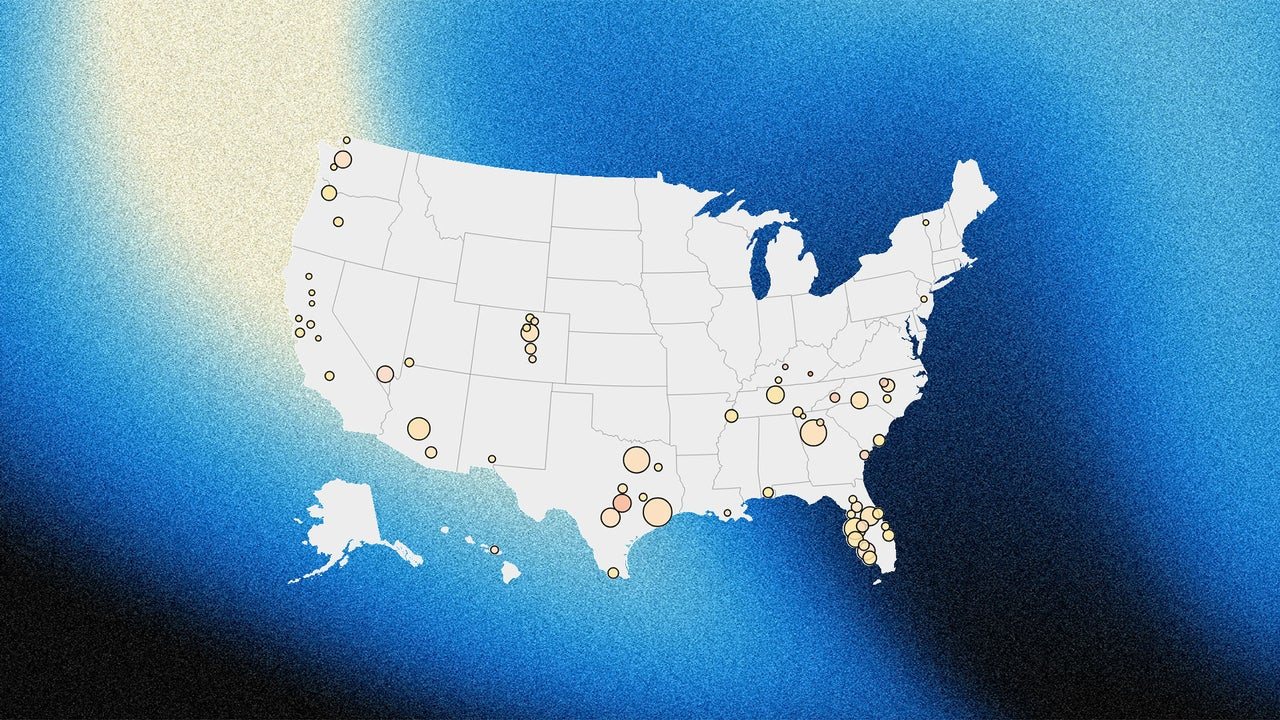
Home prices are falling in a growing number of major American housing markets, even as the national market remains slightly positive. According to an analysis of the Zillow Home Value Index by ResiClub, 66 of the nation's 300 largest housing markets, or 22 percent, recorded a year-over-year price decline for the period ending September 2026. That is up from 54 markets, or 18 percent, in the August reading.
Nationally aggregated U.S. home prices rose 1.0 percent year over year between September 2025 and September 2026, a slower pace than the 1.3 percent gain recorded in the prior month. The softening comes as long-term yields and mortgage rates have recently risen. The 30-year fixed mortgage rate has moved back above 7.00 percent, adding pressure to an affordability environment that was already strained.
The declines are concentrated in parts of the Sun Belt and the Mountain West. Among the 50 largest metro housing markets, 17 posted negative year-over-year price growth. Areas in Texas, Florida, Washington and Colorado, where active inventory now exceeds pre-pandemic 2019 levels by a considerable margin, are seeing material corrections, modest price pullbacks or flat pricing. By contrast, some areas in the Northeast and Midwest, where inventory remains well below 2019 levels, are still seeing modest price increases.
Many of the weakest markets were among the strongest during the pandemic housing boom, when prices in the Sun Belt and Mountain West surged, often outpacing local income growth. As pandemic-driven domestic migration slowed and mortgage rates rose in 2022, markets such as Tampa and Austin struggled to sustain prices that local incomes could not easily support. ResiClub notes that an abundance of new home supply in the Sun Belt has added to the softening. Builders have often lowered prices or offered affordability incentives to keep sales moving, which has also cooled the resale market as some buyers choose new construction instead of existing homes.
The gap between rising and falling markets has widened beyond its typical range. Home prices in the Hartford, Connecticut metro area are now 28.6 percent above their 2022 peak, while prices in the Austin, Texas metro area sit 28.1 percent below theirs. ResiClub attributes part of that divergence to mean reversion, since many of the sharpest declines have occurred in markets that overheated most during the boom.
Even where prices are still rising, most gains are running below both income growth and consumer price inflation, which economists describe as real home price declines. ResiClub recommends that buyers, sellers and observers closely monitor local active inventory over the coming months, as the direction of prices in many metros will likely depend on how much supply continues to build as mortgage rates stay elevated.
5