Memorandum
- From
- Derek Weston via MarTech
- Date
- Filed
- Business·4 min to read
- Re
Google Ads Seasonality Adjustments Backfire on Black Friday, Study Finds
ReGoogle Ads Seasonality Adjustments Backfire on Black Friday, Study Finds
A three-year analysis of over 5,000 Google Ads accounts shows that using seasonality adjustments during Black Friday and Cyber Monday led to higher costs and lower returns, as Smart Bidding already anticipates the surge.
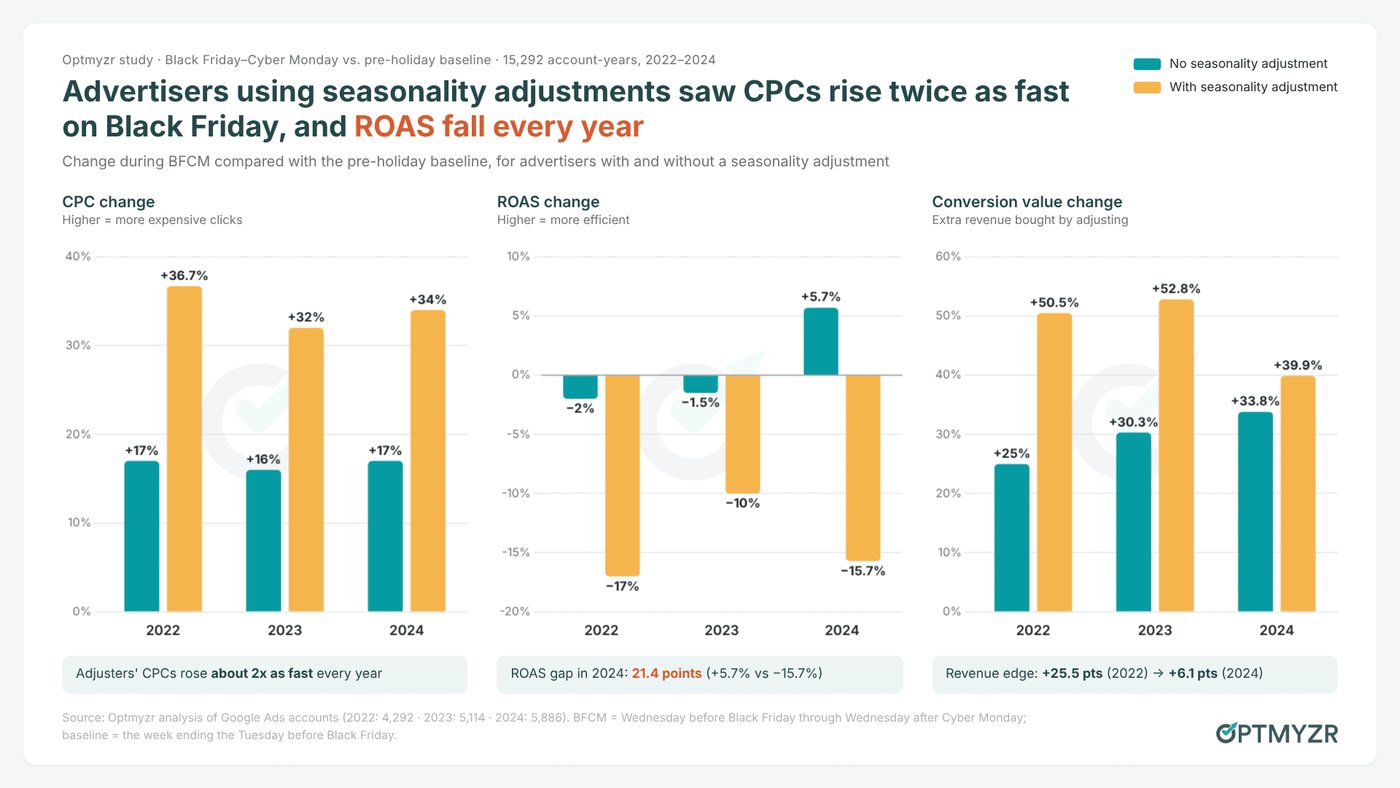
Advertisers who apply seasonality adjustments to their Google Ads campaigns during the Black Friday–Cyber Monday period are paying significantly more for clicks and earning less on their ad spend, according to a new analysis of more than 5,000 accounts. The study, conducted by ad automation platform Optmyzr, found that in 2024, advertisers using adjustments saw cost per click (CPC) rise 34% compared to the pre-holiday baseline, while those who left Smart Bidding untouched saw CPCs increase only 17%. More critically, return on ad spend (ROAS) fell 15.7% for the adjustment group, whereas the non-adjustment group enjoyed a 5.7% increase in ROAS.
The pattern held across three consecutive years. Optmyzr compared advertisers who set seasonality adjustments for the Black Friday–Cyber Monday window against those who did not, covering tens of billions of impressions from 2022 through 2024. In every year, CPCs rose about twice as fast for the adjustment group. The extra revenue generated by adjustments also came at a steep and growing cost: in 2022, advertisers using adjustments grew conversion value about 25 percentage points more than others, but by 2024 that advantage had shrunk to just 6 points, while the ROAS penalty exceeded 21 points.
Seasonality adjustments are a Google Ads feature that tells Smart Bidding to expect a specific percentage change in conversion rates, prompting the system to raise bids accordingly. The problem, according to the analysis, is that Google’s Smart Bidding already knows Black Friday is coming. The system is trained on years of historical data from millions of advertisers and reacts to real-time auction signals. Adding an adjustment on top of that effectively double-counts the expected lift. If an advertiser predicts a 20% conversion rate increase but the actual rise is only 7.5%—as was the case for the average non-adjustment advertiser in 2024—Google overbids across every auction at the most expensive time of the year.
The data also shows that the Black Friday conversion rate bump is shrinking. Among advertisers who did not use adjustments, conversion rates rose 17.5% over baseline in 2022, 11.9% in 2023, and just 7.5% in 2024. Shoppers are spreading their purchases across a longer promotional season, flattening the peak. As a result, anyone setting an adjustment based on what Black Friday “usually” does is likely overestimating the lift and overbidding as a consequence.
Optmyzr notes one caveat: the comparison is between two groups of advertisers, not a controlled experiment. Advertisers who use seasonality adjustments may also be more aggressive about volume in other ways. However, the consistency of the pattern over three years and at such scale is a strong signal. The company recommends leaving seasonality adjustments off for widely recognized holidays like Black Friday, Cyber Monday, and Christmas. Instead, advertisers who want to trade some efficiency for more volume should lower their target ROAS directly, which clearly signals what they are willing to pay.
Seasonality adjustments still have a role for events Google cannot anticipate, such as a flash sale, a surprise clearance, a friends-and-family promotion, or a niche industry event with no broad historical pattern. For predictable peaks, the advice is to use guardrails rather than overrides. That means checking inputs before the sale and monitoring outputs during it, rather than trying to forecast the week. With an AI assistant connected to ad data, advertisers can review performance, change history, alerts, feed issues, and analytics across accounts to catch problems early. The study suggests that for Black Friday, the best adjustment may be no adjustment at all.
4