Memorandum
- From
- Delaney Sawyer
- Date
- Filed
- Politics·4 min to read
- Re
What the Sunshine Protection Act would actually change
ReWhat the Sunshine Protection Act would actually change
The House has voted for permanent daylight saving time, but the bill is still in the Senate and its legal mechanics are more precise than “stop changing the clocks.”
The most useful way to understand the Sunshine Protection Act is to separate three questions that are often collapsed into one: whether Americans should change clocks twice a year, whether daylight saving time should become permanent, and who has the legal authority to make that choice.
The House answered the second question on July 14. It passed H.R. 139 by 308 votes to 117, sending the measure to the Senate. On July 15, the Senate received the bill, read it twice and referred it to the Committee on Commerce, Science, and Transportation. As of August 10, no Senate passage appears in the official record.
So nothing has changed yet for household clocks. The existing federal system remains in force.
The bill’s legal design is worth reading closely. H.R. 139 would repeal the section of the Uniform Time Act that creates a temporary daylight-saving period. It would also move the federal standard for each time zone ahead by one hour. In practical terms, most places that currently switch between standard time and daylight saving time would stay on the clock they use in summer.
The legislation also addresses states and areas that have opted out of daylight saving time. Under current law, the Department of Transportation explains that states may exempt themselves from DST but cannot choose permanent DST independently. The House bill creates a path for areas exempt before enactment to preserve their existing standard rather than being forced onto the advanced clock.
That distinction matters because the federal debate has produced years of conditional state laws. Nineteen states have enacted legislation seeking year-round daylight saving time if federal law permits it, according to the National Conference of State Legislatures as cited by CNN.
The political coalition is broad but not uniform. President Donald Trump supports ending the clock-changing ritual and backed the House approach. House supporters describe permanent DST as a way to provide predictable evening daylight and reduce the inconvenience associated with the spring and autumn switches.
Health organisations agree with only part of that argument. The American Academy of Sleep Medicine supports abolishing seasonal changes, but it recommends permanent standard time. Its position says standard time is better aligned with human circadian biology. The American Medical Association has adopted the same basic preference.
That means the scientific disagreement is not primarily about whether losing or gaining an hour twice a year can disrupt sleep. The more consequential long-term question is where society places daylight relative to work, school and sleep: earlier in the morning or later in the evening.
Winter exposes the trade-off. Permanent DST would produce later winter sunrises in many northern and western locations. Critics worry about children and commuters beginning the day in darkness. Supporters put more weight on having additional usable daylight after school and work.
History adds caution. The United States experimented with year-round daylight saving time during the 1970s energy crisis and Congress changed course in 1974. That episode does not prove the same outcome would occur today, but it prevents the current proposal from being treated as an entirely new idea.
The cleanest summary is therefore procedural. The House has made a clear choice for permanent DST. The Senate has not yet matched it. If the Senate passes the same text and it becomes law, the federal clock system would be redefined rather than merely frozen in place.
Until that happens, the twice-yearly clock change remains the law for most Americans.
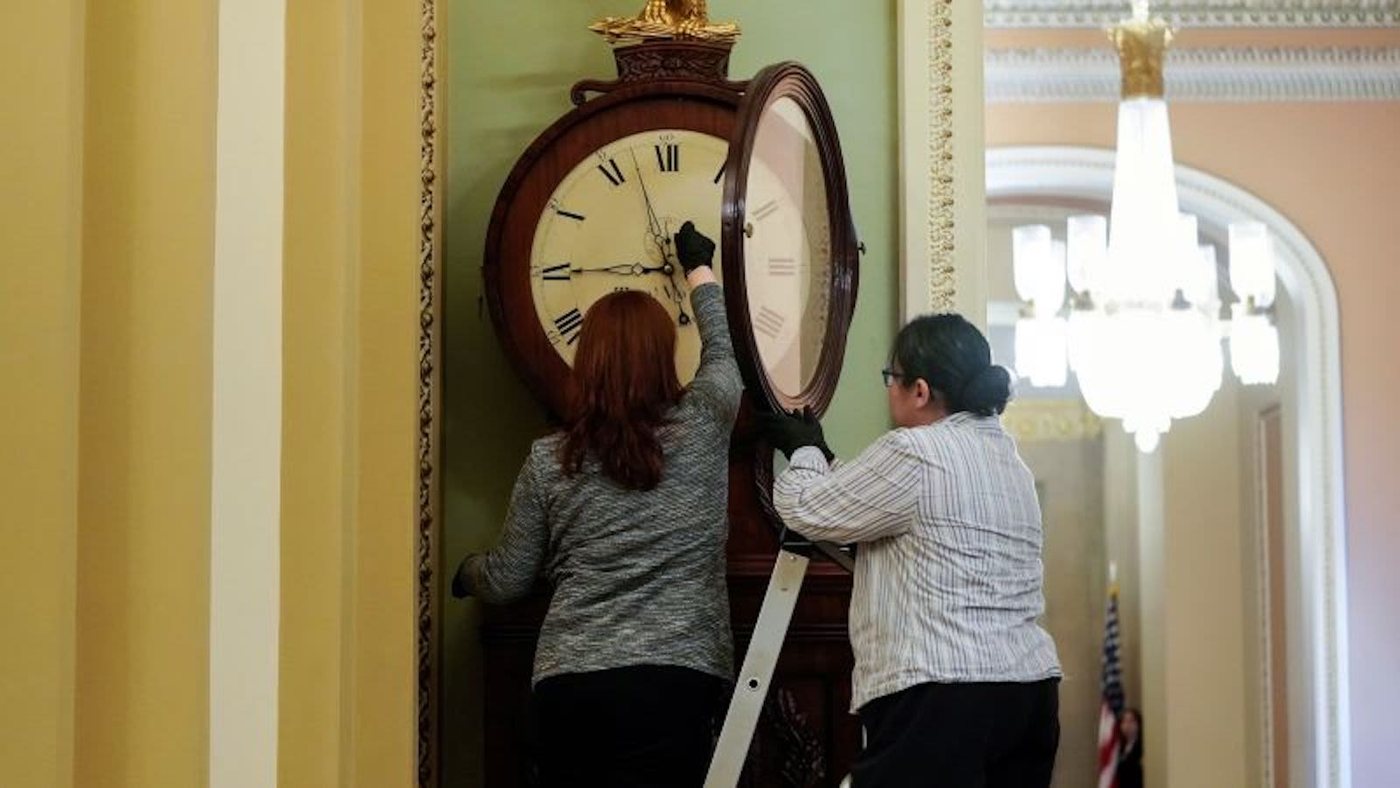
Image: U.S. Capitol staff adjust a clock for a seasonal time change. Image source: CNN.
65