Memorandum
- From
- Caroline Mercer via fox - Most Popular
- Date
- Filed
- Politics·5 min to read
- Re
Michigan voters back guaranteed income as El-Sayed signals support
ReMichigan voters back guaranteed income as El-Sayed signals support
Supporters of Michigan Senate nominee Abdul El-Sayed told reporters in Detroit that guaranteed income programs are a good idea, as the progressive candidate has signaled backing for direct-cash poverty interventions.
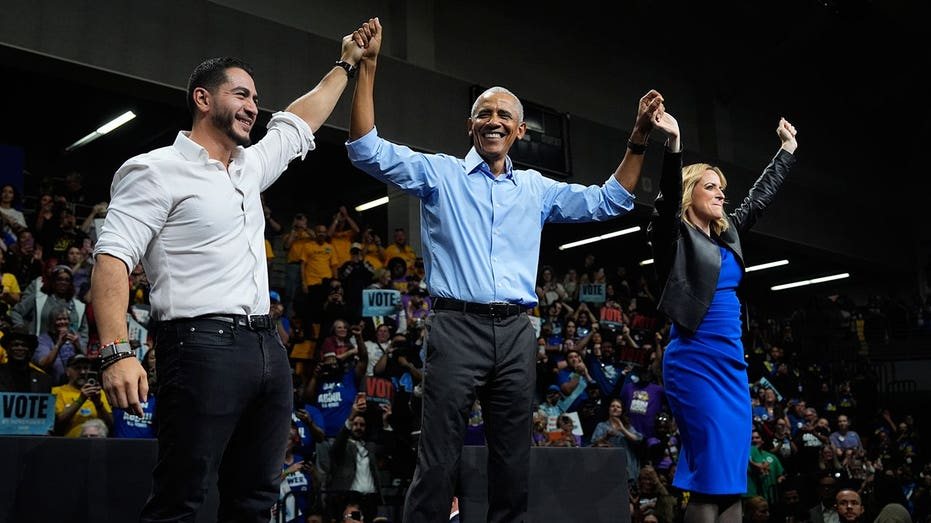
Supporters of Michigan Democratic U.S. Senate nominee Abdul El-Sayed expressed backing for guaranteed income, a social safety net concept that has gained traction in cities across the country. Several rallygoers said direct cash assistance could help households struggling with rising prices and cuts to existing programs, and at least one said he hoped El-Sayed would make the idea part of his campaign.
The comments were gathered outside Cass Technical High School in Detroit, where El-Sayed held a rally featuring former President Barack Obama. The event was a notable moment in the progressive candidate's effort to strengthen ties with the Democratic establishment as he seeks to succeed retiring Sen. Gary Peters, D-Mich. Voters leaving the overflow venue were asked whether guaranteed income programs are effective policy and whether El-Sayed should make them a core pillar of his campaign.
Responses were mixed in their conditions. One voter, identified only as Dave, said he supported the concept and argued that billionaires should pay for it. Kiana Montgomery, a publicist, also backed the idea but said there should be parameters on how recipients can spend the money. "A rising tide lifts all ships, and if people are in need, we should definitely support them," Montgomery said. Tammy Bacon, another supporter, said El-Sayed should campaign on the issue, citing women's needs in healthcare. A Bloomfield Hills resident, Mohammed, said targeted assistance could work if it is managed properly.
El-Sayed has previously signaled support for direct-cash poverty interventions, including at the "Guaranteed Income Now" summit in Detroit. There he described a pilot his campaign would propose in Wayne County to invest $500 a month in young parents enrolled in community college. "How do we address poverty at that transition between generations in a family? We've got too many parents trying to do the impossible: to go to school, to raise kids, and to earn a living all at the same time," El-Sayed said at the summit.
His broader campaign platform focuses primarily on universal healthcare through Medicare for all, raising the minimum wage and expanding existing federal safety net programs. The summit was hosted by the Economic Security Project, an advocacy group founded in 2016 by entrepreneurs, activists and researchers that has helped launch more than 100 guaranteed income pilots nationwide. Such initiatives are typically structured as temporary, no-strings-attached pilots designed to measure the economic and health effects of direct cash support.
The debate comes as Rx Kids, a public-private cash aid initiative for expectant mothers and infants, expands across Detroit and other Michigan cities. The program provides eligible pregnant women a one-time, unconditional $1,500 payment, followed by $500 per month for up to 12 months after birth. Organizers describe the model as a targeted child allowance rather than traditional universal basic income, but critics argue both rely on direct cash transfers.
Michigan House Republicans have questioned the initiative's oversight and spending, which has secured nearly $400 million in combined public and philanthropic funding. House Oversight Committee Chairman state Rep. Jay DeBoyer, R-Clay Township, criticized the lack of spending guardrails, arguing that unconditional cash amounts to a "redistribution of wealth" rather than a solution to systemic poverty. Republican lawmakers have also raised concerns about transparency and administrative costs, noting that GiveDirectly, the nonprofit administering the program, receives tens of millions of dollars in fees. Conservative policy groups argue such programs undermine workforce participation and deepen government dependency.
Proponents point to data from more than 250 cash transfer pilots across 40 states and Washington, D.C., which they say show direct cash can reduce infant poverty and improve health outcomes. Detroit is among more than 100 U.S. municipalities that have experimented with basic-income-style pilots since 2018. With temporary federal COVID-19 relief funds exhausted, local leaders are searching for permanent funding. In Cook County, Illinois, commissioners allocated $7.5 million in local taxpayer funding to continue the county's guaranteed income program as a permanent budget initiative.
4