Memorandum
- From
- Delaney Sawyer
- Date
- Filed
- Culture·5 min to read
- Re
The Two Peaks of Dolly Parton’s Career
ReThe Two Peaks of Dolly Parton’s Career
One peak belonged to the songwriter of the early 1970s. The other belonged to the crossover star of the late 1970s and early 1980s. Understanding both explains the unusual durability of Dolly Parton’s legacy.
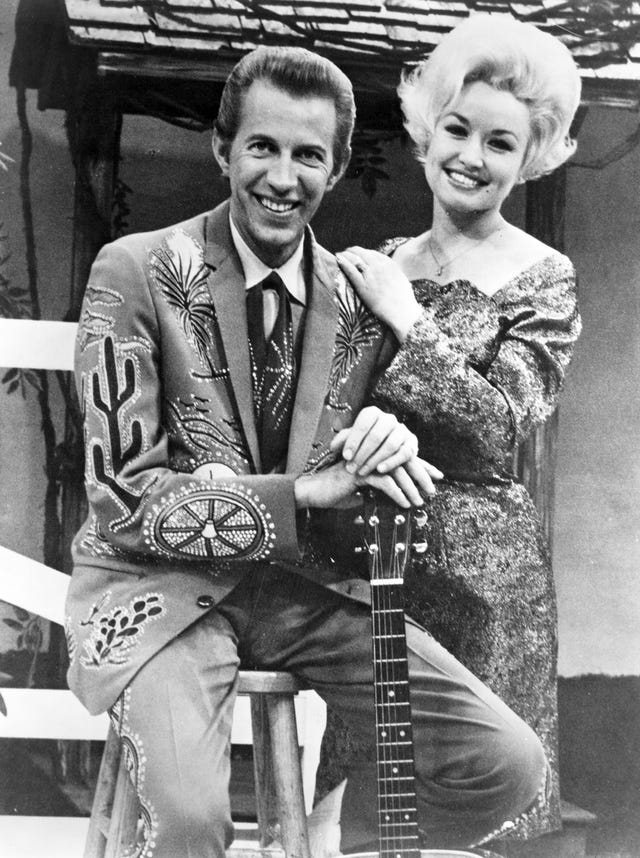
There is no single year that explains Dolly Parton at her peak. Her career makes more sense as two overlapping summits: an artistic high point in the early-to-mid-1970s, when her country songwriting reached extraordinary concentration, and a mainstream high point from 1977 into the early 1980s, when the same identity expanded into pop radio and film.
That distinction matters as the culture looks back on Parton following her death in Nashville at 80. The temptation with a career this long is to flatten it into a list of hits and honors. The more useful story is how one phase made the next possible.
Parton was born in Locust Ridge, Tennessee, in 1946, the fourth of 12 children. She was performing publicly by childhood and made the Grand Ole Opry at 13. Her move to Nashville after high school eventually led to The Porter Wagoner Show, which she joined in 1967. Wagoner’s program provided a national audience and a major-label structure, but Parton’s ambition was never limited to remaining a television duet partner.
The first peak arrived as she established a solo catalog. “Joshua” became her first solo country No. 1 in 1971. Three songs reached the top in 1974: “Jolene,” “Love Is Like a Butterfly” and “I Will Always Love You.” The Country Music Hall of Fame explicitly identifies the early-to-mid-1970s as the most creatively fertile period of her country career. She won CMA Female Vocalist of the Year in 1975 and 1976.
The achievements were not simply numerical. “Coat of Many Colors” used an episode of childhood humiliation to write about poverty, family pride and the meaning people attach to possessions. “Jolene” placed jealousy in a direct address so vivid that listeners could see both women. “I Will Always Love You,” written as Parton prepared to leave Wagoner’s show, made professional separation sound like an act of gratitude rather than revenge.
That last song also became a measure of the catalog’s portability. Parton’s original topped the country chart in 1974, a new recording returned to No. 1 in 1982, and Whitney Houston’s 1992 version turned it into one of pop’s defining ballads. The writer’s work could survive a radical change of singer and arrangement.
The second peak began when Parton deliberately widened the market. “Here You Come Again” reached No. 3 on the pop chart in 1977 and helped deliver her first Grammy. She won CMA Entertainer of the Year in 1978. Her movie debut in “9 to 5” followed in 1980, and the title song hit No. 1 on both the country and pop charts in 1981, winning two Grammys and earning an Oscar nomination. In 1983, “Islands in the Stream,” her duet with Kenny Rogers, topped the pop, country and adult contemporary charts.
The sequence is a useful answer to the question of when Parton was “biggest.” If the standard is songwriting density, 1973-1975 is the strongest case. If the standard is total cultural visibility, the years around “Here You Come Again,” “9 to 5” and “Islands in the Stream” are harder to beat.
What followed was not decline so much as expansion into other forms. Dollywood opened under her name in 1986 and grew into Tennessee’s most-visited tourist attraction, consistently receiving more than two million visitors annually. In 1995, Parton launched the Imagination Library in her home county because her father had never learned to read or write. By August 2026, the program had distributed more than 330 million books worldwide.
The institutions changed the meaning of her fame. Instead of merely licensing a celebrity image, Parton built structures that connected her global recognition back to East Tennessee. The park put the Smoky Mountains at the center of an entertainment business. The literacy program converted a family memory into a scalable public service.
Her late-career numbers show that those two earlier peaks kept generating attention. The Recording Academy credits her with 10 Grammys and 55 nominations. She entered the Country Music Hall of Fame in 1999 and the Rock & Roll Hall of Fame in 2022. On Aug. 19, 2026, her official organization announced 82 new sales certifications across 14 countries.
Parton’s career therefore resists a simple rise-and-fall timeline. The songwriter’s peak created the material. The crossover peak created the mass audience. The decades afterward turned both into an ecosystem of recordings, institutions, philanthropy and influence. That is why a song written in 1973 can still sound current to someone hearing it for the first time more than half a century later.
59