
Memorandum
- From
- Derek Weston via Fast Company
- Date
- Filed
- Business·6 min to read
- Re
AI CEOs Press Washington for Data Centers, Permits, and Lighter Rules
ReAI CEOs Press Washington for Data Centers, Permits, and Lighter Rules
President Trump convened top AI executives at the White House, where Nvidia, Meta, Google, Anthropic, and OpenAI pushed competing priorities on regulation, chip exports, and federal AI spending.
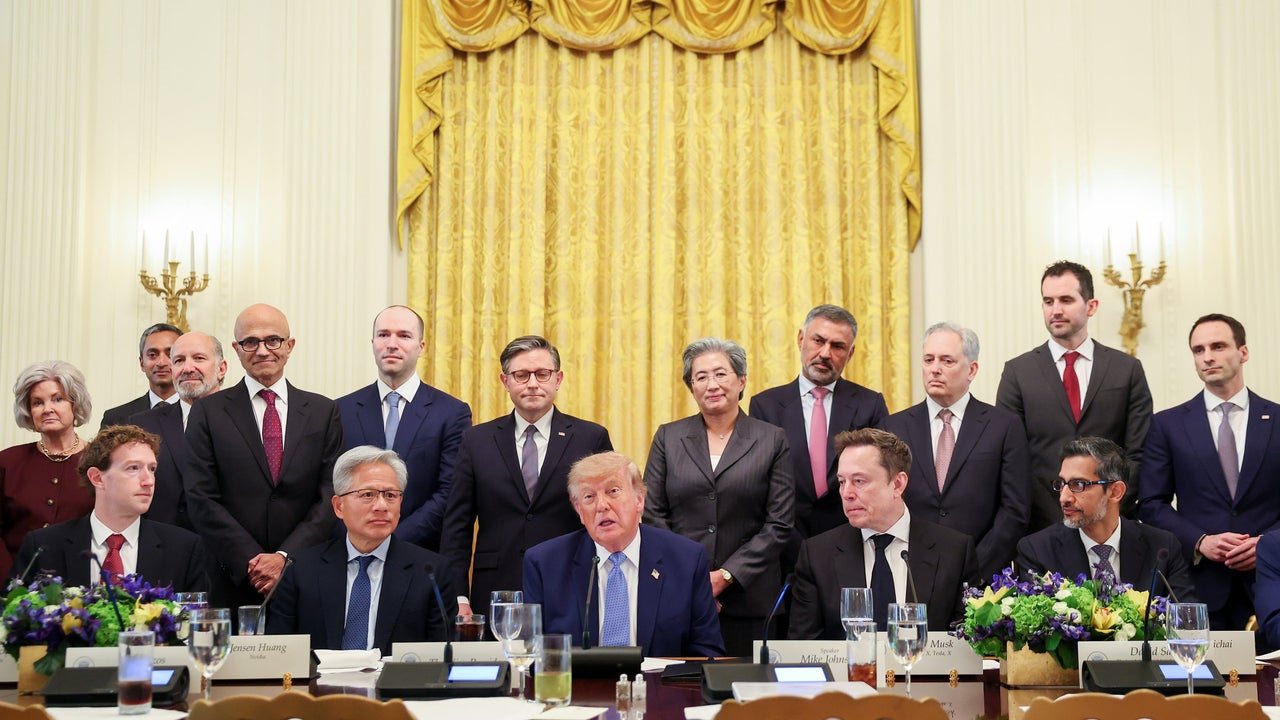
President Donald Trump brought many of the most powerful figures in artificial intelligence to the White House, including Nvidia CEO Jensen Huang, Meta CEO Mark Zuckerberg, Google CEO Sundar Pichai, and Anthropic CEO Dario Amodei. The gathering gave the industry a direct chance to press its case on the policies that will shape how quickly AI is built and deployed in the United States.
At a high level, the executives want a similar set of things: more data center capacity, faster permitting, more federal spending on AI, and a light or nonexistent regulatory touch. But their priorities overlap only partly, because their businesses give them different stakes in the details. Some are pushing the federal government to impose new rules on the most powerful AI systems, while others are fighting restrictions on chip exports.
Anthropic has spent much of the past year arguing that the most advanced AI makers need more government oversight, even though that would likely mean new requirements on Anthropic itself. Its proposed regulatory ladder would make rules tougher as systems become more capable, eventually bringing in external testing and incident reporting. The company says its Advanced AI Framework can serve as a road map for policymakers, including giving governments authority to block or slow high-risk deployments.
Amodei arrived at the meeting after months of friction with the Trump administration over the Pentagon’s use of Anthropic’s Claude. In March, after Anthropic refused to drop restrictions on mass domestic surveillance and fully autonomous weapons, the Pentagon designated the company a supply-chain risk. Anthropic challenged the move, but a federal appeals court upheld the designation in September. Relations appear to be thawing, as Trump hosted Amodei for a private dinner a few days before the larger White House gathering.
Nvidia, as a leading chipmaker, benefits as the AI industry builds more models and data centers. CEO Jensen Huang has said governments should regulate real harms instead of trying to predict every possible risk. At a G20 event in September, he said policymakers should focus on practical and actual harm rather than theoretical and hypothetical harm. The Wall Street Journal reported that Huang confronted Amodei at the White House meeting over his public warnings about AI risk.
Nvidia also has billions riding on U.S. controls on exports of advanced AI chips to China. The government has repeatedly restricted which Nvidia processors can be sold there without a license. In 2025, those restrictions left Nvidia with $4.5 billion in charges related to H20 chips it could no longer freely sell in China. More recent rules have allowed the company to resume some sales, but Nvidia says it has been able to ship only a fraction of the H200 chips approved for export. The company warns that losing access to China gives local competitors more room to grow.
Meta, a pioneer in open-source AI, has a strong stake in whether the federal government draws a regulatory distinction between closed frontier models and open ones. Restrictions on how advanced models can be released or distributed could cut directly against the strategy Meta has spent years pursuing. In an August essay, Mark Zuckerberg claimed that restrictions on access to leading open-source models could concentrate AI in fewer hands. He argued the U.S. needs to lead in open-source AI because those models are likely to become more popular globally and represent an opportunity to extend soft power.
Zuckerberg also warned against rules that narrow what data American developers can use for training or restrict model distillation, the practice of training one AI system on the outputs of another. He says those limits could leave American models at a disadvantage to Chinese competitors.
Google has called for preserving access to data for model training, expanding energy supplies, streamlining federal AI procurement, and avoiding export controls that shut American companies out of foreign markets. It has also pushed the federal government to preempt what it calls a chaotic patchwork of state rules governing frontier AI. CEO Sundar Pichai has argued that governments should address risks without stymying innovation and avoid fragmented regulatory regimes. Google has more exposure to federal AI policy than most rivals because it builds frontier models, sells cloud computing, operates massive data centers, sells AI tools to businesses and governments, and runs the world’s dominant search engine.
OpenAI, like Anthropic, wants federal rules for companies building the most powerful AI systems. But Anthropic has gone further in what it wants regulators to be able to do. Last month, OpenAI recommended Congress enact mandatory, capability-based national AI safety requirements that include common testing standards, independent assessments, and mandatory reporting of AI-related security breaches. The company argues that the strongest requirements should apply to the small number of labs at the frontier.
5